Five Parts, Infinite Possibilities: Avi Ben Shushan and Tamar Eisenberg Blend Material and Technology

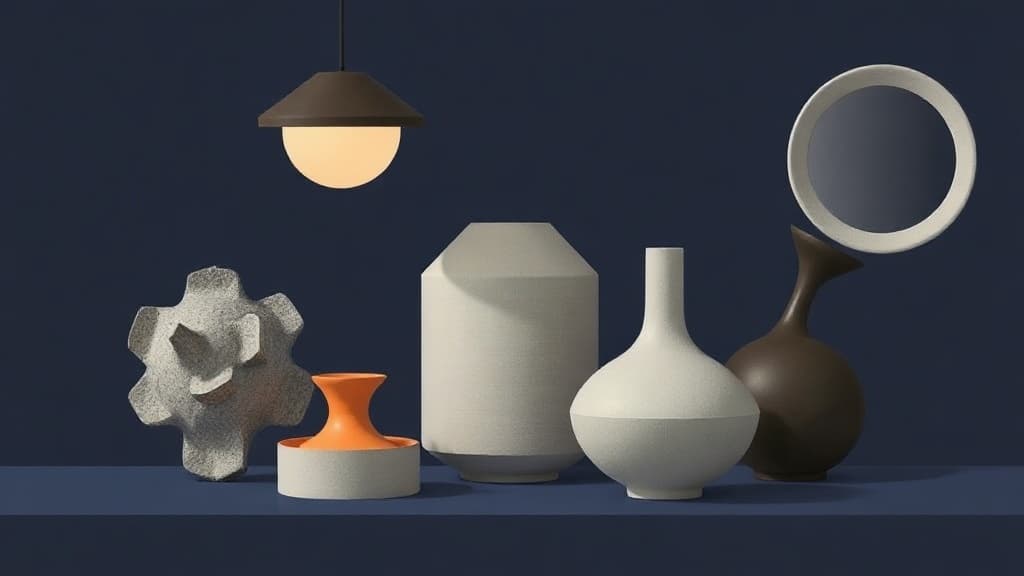
The joint project by designers Avi Ben Shushan and Tamar Eisenberg, which will be unveiled for the first time at the Fresh Paint fair, taking place this year from June 24 to 29, may offer a system of modular molds for ceramic casting, but it challenges the saturated industrial model and offers a new interpretation of ceramic production methods. The formal language is uniform and repetitive, because the objects are made up of five basic shapes, yet the possibilities are endless. "Theoretically we can produce a cup or a small vase, a 20 by 20 cube or a meter and a half by a meter and a half, and if we want, even a building," says Ben Shushan. "It is an interesting dialogue between what we design and think about form and an object schema. That is, if we want to produce an object from the molds that will be a lighting fixture, our options are limited by what the language of the molds allows us. The product language exists in the schema, and beyond that everything can change, the scale, the use, the color, the finish," adds Eisenberg.
Eisenberg, who specializes in objects and lighting fixtures and researches the relationship between material, light and structure, and Ben Shushan, who developed a precise design language in his ABS Objects brand based on local visual cultural motifs, have created a colorful series of items together, including lighting fixtures, vases, mirrors and sculptures. Their project, Plaid, won the Zvi Yemini Prize for Design, and it enables the creation of a wide range of three-dimensional forms without any limitation of size, volume or shape, in an original and interesting aesthetic language. They studied industrial design at Shenkar, where they met, and about two years ago began working together. The project gained momentum when they were accepted to a residency in Italy last summer. "We researched modular molds that each time you assemble them, something different comes out," says Ben Shushan. "There is something infinite in this project, and we keep learning."
At Fresh Paint, they are presenting 20 variations of different objects. Eisenberg explains: "Our current limitation is the studio and what is in it, for example the size of the kiln allows us to produce on a small and medium scale. But in principle the method can work on larger scales. I think less about formal design because I like to think from the constraints of technology and the method. That is why the project suits both of us, not focusing on one specific thing. דווקא the technical limitations allowed us to design unique objects."
Their work process begins with deciding on the object, and then they assemble a mold like a puzzle, pour ceramic material into it, take the mold apart and move on to the painting stage. According to Eisenberg, "On the face of it, creating in this space is a limitation, but there are endless possibilities in which Avi's and my design eye come into play. The final product looks like something we made together. When we know the language, the dialogue between us as designers allows room for action."

