
Drone Threat Exposes a Gap in Israel's Defenses
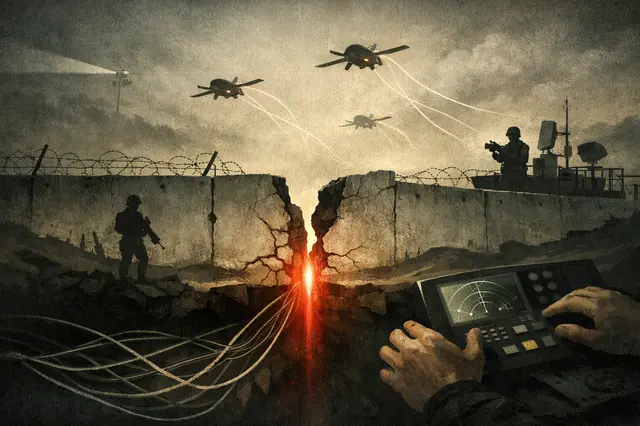
A ynet daily news podcast episode examines why drones have become such a difficult challenge for Israel’s security forces. The discussion says drone warfare took off mainly in the Russia-Ukraine war, where both sides used explosive and surveillance drones, while Hezbollah had already used drones in Syria’s civil war. Drones were also used in the October 7 attack and throughout the war in Gaza, according to the segment.
Dr. Yehoshua Kalisky, a senior researcher at the INSS, said the drones used against Israeli forces are guided by fiber-optic cable, making them almost impossible to neutralize. “All communication is done through the fiber-optic cable, so there is no way to use electronic warfare to disable them,” he said. He added that there was some preparation for the drone threat and that the fact of drone use did not surprise anyone, only the scale did.
According to Kalisky, early in the war the military installed mesh roofs on tanks to protect them from drones, but fiber-optic models pose a different problem because they are small, hard to detect, and difficult to intercept with technological means. Lt. Col. G., head of the Borders and Exposure branch, said such drones cannot be identified by electronic warfare tools, fly very low, and are not always visible to some radar systems. He said they have navigation immunity and resistance to electronic warfare systems, can reach speeds of 60 to 100 kilometers per hour, and are therefore a relatively new threat, about two years old.
The segment also emphasized that drones are cheap compared with missiles and other weapons systems, which require expensive infrastructure and industry. A drone can be bought at an electronics store, and even if it is not an explosive drone, it can still have the same components as one. The podcast also promoted a related episode about the fighting on the northern border despite the ceasefire.



Ask About This Article
Duki reads it, and every newsroom on the same story, then answers with sources.