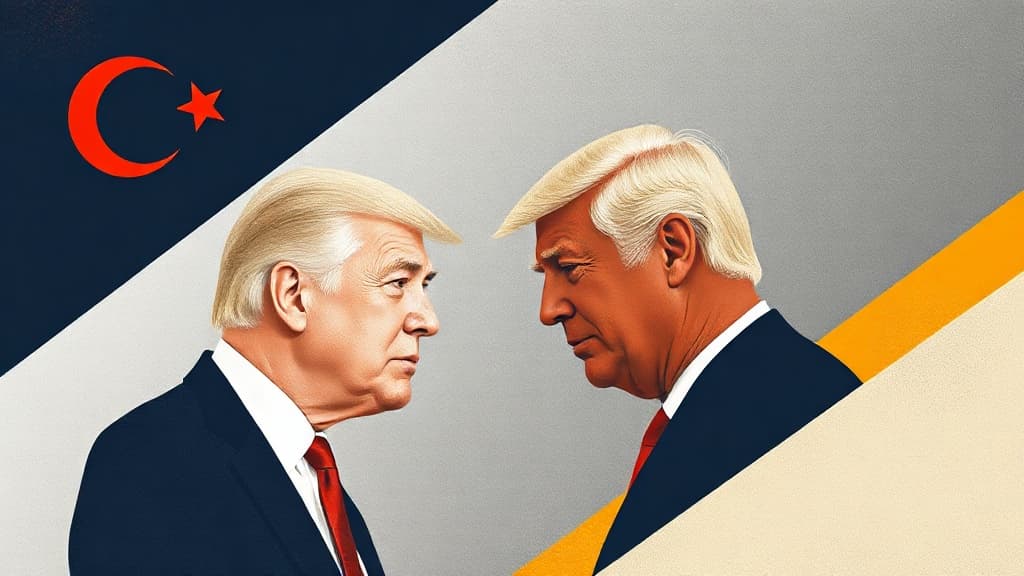
Behind Erdogan’s Remarks and Trump’s Promise: “There Will Be No Clash as Long as I Am President”

Jerusalem is no longer surprised by Turkish President Recep Tayyip Erdogan’s attacks on Israel. On Wednesday, Erdogan said that Israeli strikes in Syria and Lebanon had “reached the point where they also threaten Turkey.” According to him, “We see malicious initiatives led by Israel also in the Mediterranean Sea, and no one should go chasing adventures there.”
Prime Minister Benjamin Netanyahu responded by saying that “the antisemitic tyrant Erdogan, who commits genocide against the Kurds, supports the Hamas terror organization, oppresses his own people and jails political opponents, is the last one who can preach morality to the State of Israel.” The Turkish Foreign Ministry then joined the heated exchange, issuing a sharp statement against Netanyahu, saying: “The baseless, provocative and absurd allegations directed against our esteemed President are nothing but part of Netanyahu and his accomplices’ fraud effort against international public opinion. The lies that Netanyahu, an expert on the Holocaust, utters to cover up the facts cannot conceal the responsibility for the grave crimes he has committed. We will continue to work resolutely so that they are held accountable before international tribunals for their actions, which throw law and humanitarian values into the trash.”
This rhetoric has been repeated many times, but the question is what motives drove Erdogan to launch such an unusual attack דווקא now? It appears that Erdogan is trying to exploit the growing distance between Prime Minister Benjamin Netanyahu and U.S. President Donald Trump in order to strengthen his standing on the international stage. In Turkey, the shouting match between Netanyahu and Trump is interpreted as a sign of Israeli weakness, and it is assessed that Washington is no longer giving Netanyahu full backing.
Trump himself was asked about Erdogan’s attack on Israel and about the possibility of a military clash between Jerusalem and Ankara. In response, Trump praised the Turkish president and said: “Look, he’s a very good friend of mine, and we worked together very well. I like him a lot. I’m not supposed to say that, because the media will immediately say, ‘Oh, he loves Erdogan.’ But he’s a great leader. A very strong leader. A very strong man. I didn’t hear at all about what you’re describing. If I heard something like that, I’d call him. And I think I’d make sure everything worked out. I don’t think that’s going to happen with Turkey. Not as long as I’m president. Because he respects me and I respect him. And beyond that, we have a good friendship. So we’ll see.”
At the same time, Ankara fears a tightening regional alliance between Israel, Greece and Cyprus. Cyprus accused Turkey yesterday of disrupting the operations of military aircraft carrying European defense ministers to an EU meeting on the island, and said it would file formal complaints over the incidents. The incident occurred shortly before Cyprus and France were expected to sign a security cooperation agreement in Nicosia, which regulates the legal framework for the presence of French military personnel on the island.
According to assessments, the Turkish president is trying to gain standing in the Arab world against the backdrop of the blow dealt to Iran in the war against the United States and Israel. It appears that by attacking Israel, Erdogan is trying to challenge the Islamic Republic and strengthen Turkey’s position in the Arab world.
The return of the Ottoman Empire
It should be noted that Erdogan’s remarks came just days after Turkey’s interior minister, Mustafa Cipci, said at a rally of the ruling party that Turkey would one day take control of Jerusalem. These remarks are connected to the neo-Ottoman approach and Turkey’s aspirations to restore the glory days of the Ottoman Empire.
The attack from Turkey came דווקא after relatively successful coordination between Jerusalem and Ankara over the handling of the Gaza flotilla. The Turks restrained the IHH activists, who were behind the Mavi Marmara flotilla, so that they would not act violently in the current flotilla. For its part, Israel allowed Turkey to fly all the flotilla activists to Istanbul. This required sensitive coordination between the countries. It appears that the Americans were behind the coordination, fearing a collision. Now the United States will have to step in and restrain Erdogan, so that things do not get out of control.
Against this background, the question arises of how events will develop going forward. A military clash does not appear to be on the agenda, and President Trump said as much. The Turks know that if they sever relations completely with Jerusalem, they will lose all access to Judea and Samaria, so that is likely to constrain their behavior. In Syria and the eastern Mediterranean there is potential for a confrontation, so it is not impossible that the United States or Azerbaijan will initiate dialogue between Israel and Turkey, as was done in the past in Baku. At the same time, communication channels between Israel and Turkey are still open, mainly through security channels.
The same event, reported separately by each outlet. Open a few to compare what different newsrooms emphasize — and what they leave out.


Not the same event — other stories that share this one’s people, places, or theme: background, reactions, and follow-ups.