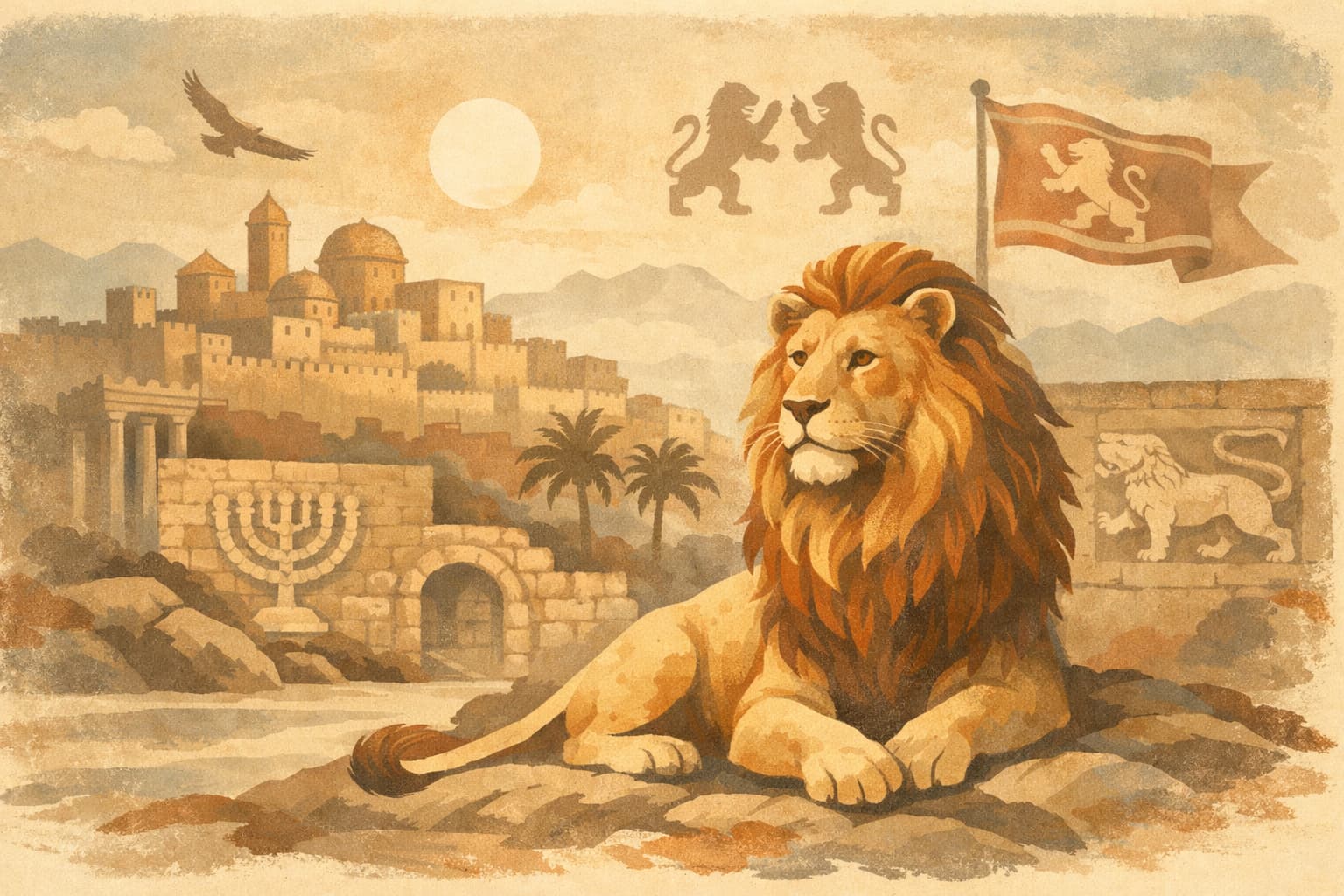
The Jewish Lion, from the Bible to Israel's Modern Symbols

The article traces how the lion has served as a durable Jewish and Israeli emblem from the Bible to the present. It opens with Haim Nahman Bialik’s 1902 poem “Mati Midbar,” which imagines one lion rising from a weak generation of desert lions, and uses that image to frame a broader look at the symbol’s history.
In the Bible, Judah and Dan are both associated with lions, with Judah tied to leadership, spiritual strength and Jerusalem, and Dan to movement, physical strength and the Dan region and Tel Aviv area. In the First Temple period, the lion became a hallmark of the House of David, most visibly on King Solomon’s throne, described as having lions on the armrests and on the six steps leading up to it. The motif later survived the destruction of the Temple and became a protective symbol in synagogue art, on Torah arks, curtains, plaques, menorahs and other ritual objects, and it also appeared in medieval heraldry and on the emblems of Jewish families such as Rothschild and Montefiore.
A new civic layer emerged in 1949, when Jerusalem chose a lion standing on its hind legs, together with the city wall, Western Wall stones and olive branches, as its official emblem. The lion figure became a shorthand for sovereignty and historical continuity. The article also notes that the Lions’ Gate was linked in national memory to the 1967 Six-Day War, even though its lions were originally the symbol of Mamluk ruler Baybars, whose name was visually echoed in the animal motif he used on buildings in several cities.
The lion kept reappearing in Israeli public symbols, including Central Command’s insignia, a 1904 seal found at Megiddo that appeared on a commemorative stamp designed by Miriam Karoly, the old five-pound note, a half-shekel coin issued by Bank Israel in 1980, and the 2023 “Am Kalavi” logo launched shortly after the start of the Gaza war. The national messaging during the Iran war, titled “Shagat Ha’ari,” also used a roaring lion. The piece closes by recalling a 1973 children’s book by archaeologist Rina Baron about a boy named Peleg and the lions of Israeli history, and says that this year’s heroes should join that long line of lion imagery.


