
How a Neighborhood WhatsApp Group Led an Israeli Mother to Donate a Kidney
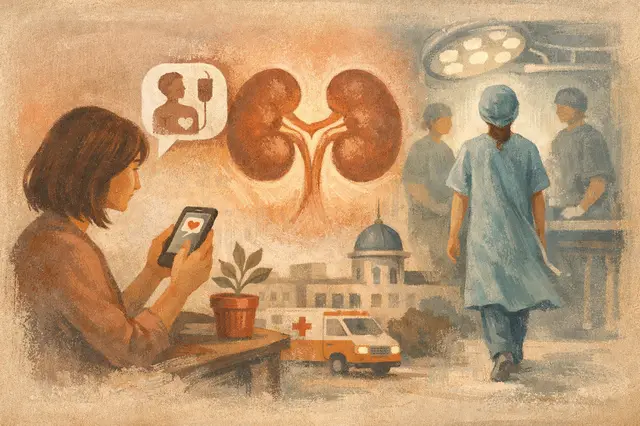
Vita Gitshtein, 37, of Hod Hasharon, says she donated a kidney after seeing a neighborhood WhatsApp message about a girl who needed one. The girl’s parents were not a match, the post said, and included a link to “Gift of Life,” a nonprofit that promotes kidney donation. Gitshtein, married with two daughters aged nine and five, studies education at Beit Berl and works as a special-needs aide in a kindergarten.
She said she filled out the initial form almost on impulse, then quickly moved into testing. Gitshtein said she felt from the start that she was a good fit because she was young, healthy, and has O positive blood, which can be donated to anyone with that blood type. Part of her hesitation came from unfamiliarity with living kidney donation. “In the religious sector it is more familiar and common, but in my secular environment I had not met people who had done this,” she said.
Her husband, an active-duty soldier who is away from home most of the week, initially opposed the idea, calling her crazy, though she said he was mainly worried about complications or a difficult recovery. Her parents also objected, including one of the toughest questions she heard, whether she would regret it if one of her daughters ever needed a kidney. Gitshtein replied that she believes in “good karma.” She also had to go through extensive medical testing and approval by a Health Ministry committee, which checks that donation is voluntary, without pressure or payment. Officials focused on her age because doctors usually prefer women donate after completing childbirth, since kidney donation can make a future pregnancy high-risk, but she said she did not plan to have more children.
She told her daughters only about two weeks before surgery, explaining simply that a girl was sick and needed a kidney and that she was a match. The night before the operation she was admitted to Beilinson Hospital and could not sleep, and on the morning of surgery she was transferred to Schneider Hospital. When she woke up, she said, her first feeling was that she had done something good in the world. Recovery took about two weeks, and she was careful to get up, walk, and return gradually to normal life.
Gitshtein met the recipient about three months later, after the child was ready, and visited her at home with her daughters. “Seeing a girl returning to school and meeting her friends is an indescribable feeling,” she said. The girl later wrote her a note ending with, “Thank you for changing my life.” Gitshtein concluded that kidney donation is not easy, “but it is not as frightening as people think,” adding that “sometimes one act by an ordinary person can open the door back to life for someone else.”




Ask About This Article
Duki reads it, and every newsroom on the same story, then answers with sources.