
Court, not ideology, should decide when road blockades are allowed
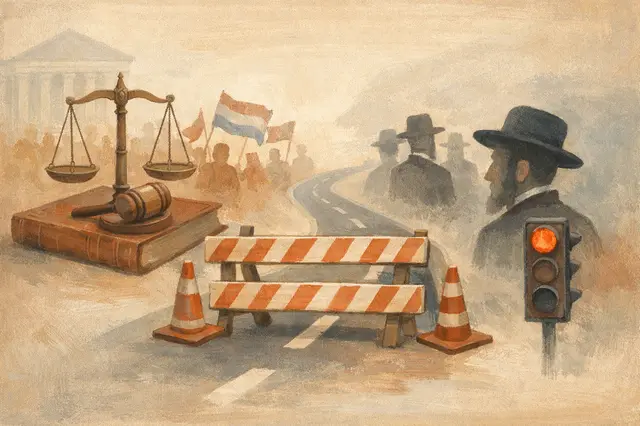
Ilan Dayan argued on Galatz that road blockades by opponents of judicial reform cannot be compared with blockades by ultra-Orthodox protesters against the enlistment law, because the first were supposedly carried out “for democracy” and the second for draft evasion. Nadav Eyal echoed that view, saying the two situations differ because the anti-reform protesters acted, in his words, “for democracy.”
The article, written by constitutional scholar Moshe Cohen-Eliya, says that argument contradicts the basic principles of free speech and equality. Citing Dayan’s own academic background, including doctoral work at Yale on the democratic theory of free expression, it argues that the state may regulate the time, place and manner of protests, but may not give greater protection to demonstrations because it agrees with their message.
The piece points to U.S. constitutional law, including a 1992 Supreme Court ruling striking down a law that banned only certain hateful expressions, and the court-approved Nazi march in Skokie, Illinois, as examples of viewpoint neutrality. It says the same principle should apply in Israel, where a road blockade is either illegal or, if tolerated as part of protest, should be treated equally regardless of whether it is done in the name of democracy or Torah study.
The article accuses Israeli enforcement of operating by a caste-like hierarchy, with Kaplan protest leaders at the top, then right-wing protesters, then ultra-Orthodox and Arab demonstrators at the bottom. It says social psychology helps explain the bias, because people tend to ascribe noble motives to their own camp and bad motives to opponents, but warns that this becomes dangerous when it shapes state institutions. Cohen-Eliya concludes that if a student answered like Dayan in an exam on constitutional law, the student would fail, while Dayan herself is allowed to make the argument on air.



