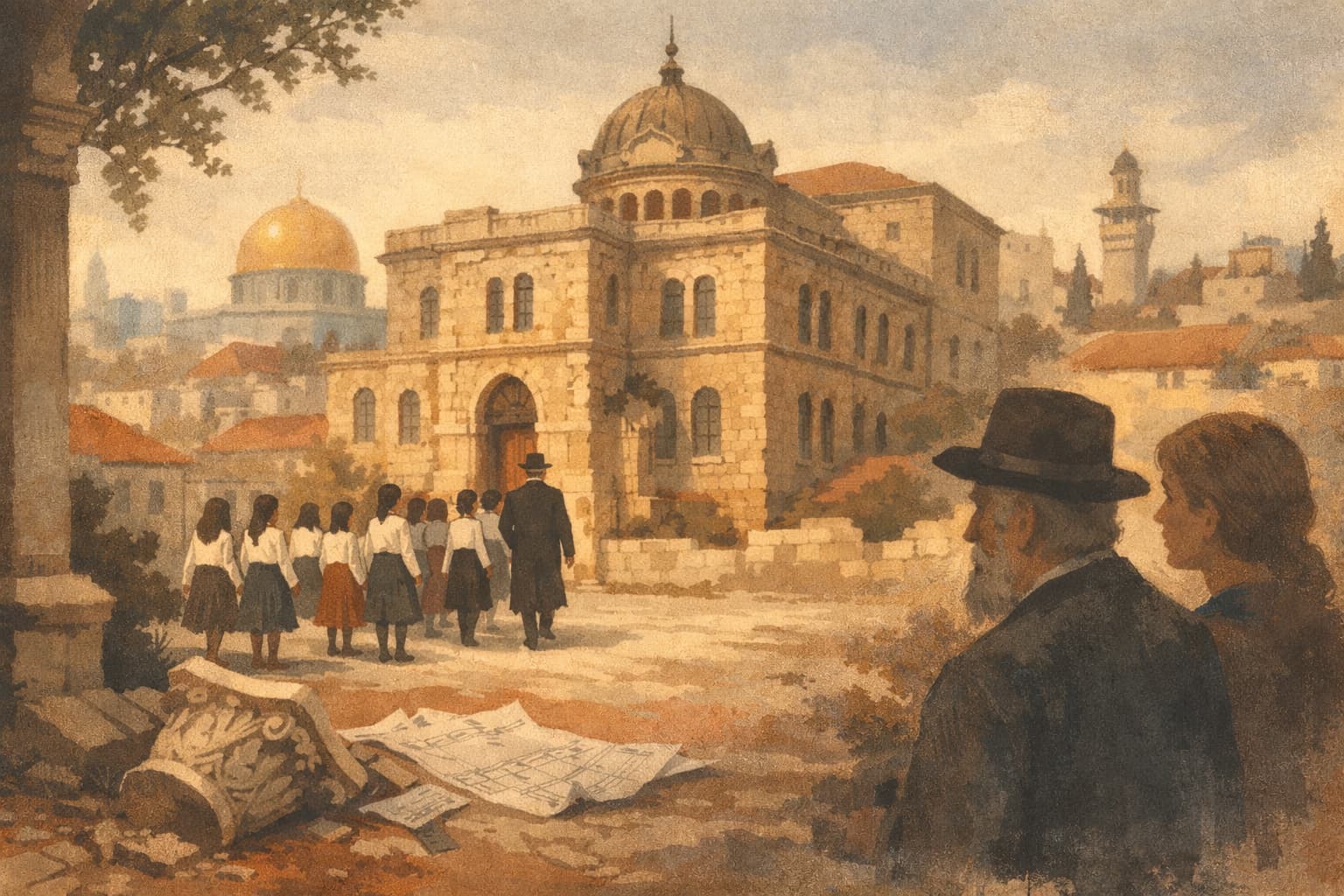
Historic Jerusalem hospital set to become a girls' school, drawing strong criticism

Jerusalem is expected to approve tonight the conversion of the former Bikur Holim Hospital on HaNevi'im Street into a girls' school run by the Slonim Hasidic community. The stone building is one of the city’s 110 monumental structures, and preservation plans for it and its surroundings were drawn up in the late 1980s. The site sits in central Jerusalem, on the southern side of HaNevi'im Street, between the ultra-Orthodox neighborhoods to the north and Jaffa Street to the south, along the main east-west axis that runs from Damascus Gate to Mahane Yehuda Market.
The hospital was originally built for the German Hospital, designed by German architect Conrad Schick, who also designed the Hansen House and Talitha Kumi in Jerusalem. The land was bought in 1908, the cornerstone was laid in 1912, and the hospital opened in 1924 with British High Commissioner Sir Herbert Samuel present. In recent years, Bikur Holim mainly served the ultra-Orthodox population in the area, including women who chose to give birth there.
According to the zoning plan for the historic building, it is supposed to remain a public structure open to the general public. The plan lists uses such as a medical center or clinic, commerce, a restaurant, cafe, exhibition hall, gallery or office building, but does not mention schools, kindergartens or other educational institutions. It does note that ground floors in new buildings may be used for commerce and public-oriented uses, which supporters of the move may argue allows a school use.
The city already approved the allocation in its allocations committee, and the Jerusalem City Council is expected to give final approval tonight. Preservation architect Tzafi Shlef, Jerusalem district director at the Society for Preservation of Israel Heritage Sites, called the move a serious mistake and said using heritage sites for sectoral or real-estate interests is a historic injustice that harms property belonging to the public. Nעם כוזר, a central Jerusalem resident and director general of the Br Kayama for Culture association, said the city urgently needs space for culture. Deputy Mayor Yossi Havilio warned that turning Bikur Holim into a large ultra-Orthodox school would draw more ultra-Orthodox residents to central Jerusalem and effectively change the area into a Haredi neighborhood. The municipality said the building is privately owned, leased by the city to meet a real educational need in the area, and that a legal and planning review found the school use consistent with the approved zoning plan; it also said the building’s heritage value will be protected in the lease agreement.


