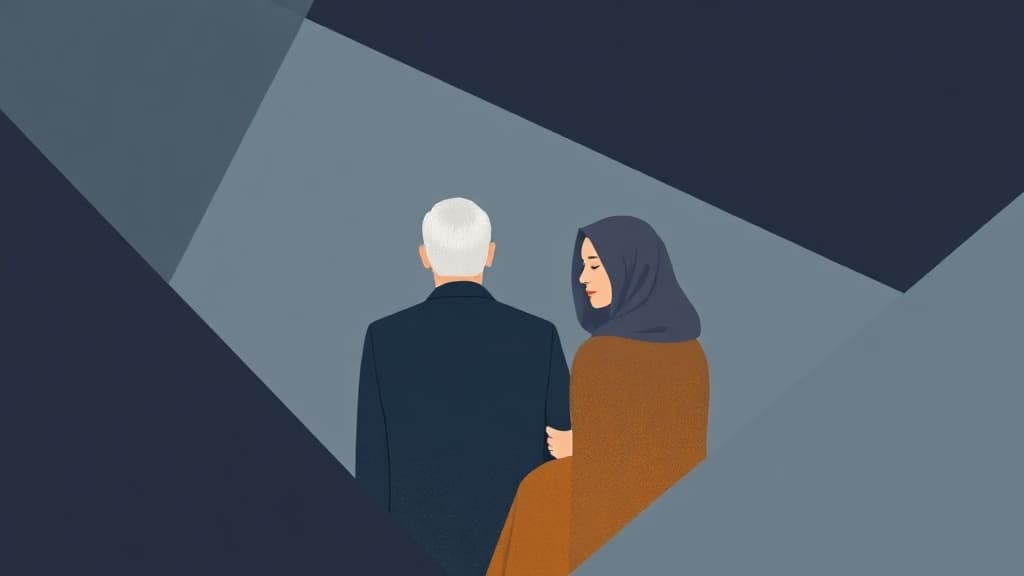
‘I Am a Husband, Brother and Caregiver’: Life Beside a Partner With Parkinson’s

In the video: Samaan Issawi in the Walla studio about life alongside a partner living with Parkinson’s disease / Editing: Sivan Shuster
When people talk about Parkinson’s, they usually talk about the person who was diagnosed, the symptoms, the treatment, the difficulty moving, and the routine that changes. But behind every patient there is sometimes also a spouse, children, grandchildren, and an entire home learning to live at a new pace. For Samaan Issawi of Nazareth, Nahida’s partner, the struggle began the moment the active, joyful and strong woman he knew began to change before his eyes.
“Nahida was a kindergarten teacher. We were happy, always happy,” he says. “She would come home, make food for the children, for the family, help out.” Then came the first signs. Difficulty in one leg, a gradual decline in functioning, visits to doctors, and eventually the diagnosis. “The doctor told her, you have Parkinson’s. She took it hard, it was difficult. We asked, what is Parkinson’s?”
“I’m with you here until the end”
For Samaan, the perspective of a partner was no less complicated. He watched Nahida struggle with actions that once had been taken for granted, but tried not to show her his fear. “I was in a lot of pain, it hurt me, but I wouldn’t show her that I was taking it to heart,” he says. “I always laughed, always supported her, so she wouldn’t feel what she was going through.”
Over time, the relationship took on another layer of care, concern and physical support. “I was a caregiver, I attended to her, whatever she wanted,” he says. “I am not just a caregiver. I was a husband, a brother, a caregiver, everything. I told her, ask me. I’m here, you have nothing to worry about.”
The struggle also affected the daily routine. Events, gatherings and going out of the house became less routine. “Sometimes she would tell me, soon I won’t be able to move, let’s go home,” he recalls. “So I would immediately hold her, and we’d go home without anyone noticing.” Still, he stresses, they tried to maintain as active a life as possible, even when it required a lot of planning, patience and help.
The whole house learns to adapt
One of the recurring points in his story is the role of the family. The children, daughters-in-law and grandchildren became part of the support circle. “The children helped us, we have three sons and a daughter, and they all saw their mother like this and started helping me,” he says. According to him, nobody leaves Nahida alone. “There is always someone by her side. If not the children, then the granddaughter, the daughters-in-law, the daughter. They always give her joy in life, so she feels she is not alone.”
In his view, that support is an inseparable part of coping: “For someone with Parkinson’s, there should always be someone by their side, encouraging them, so they have hope for life.”
Samaan does not hide that he is worn down too. But when asked where he gets his strength, his answer is simple: “It comes from love. One person loves the other.” He recalls the years when Nahida was the one caring for the home, the children and him. “Now it is our time to help her and care for her. It has to be mutual.”
“Don’t let the disease ruin things.”
Samaan Issawi, screen capture, Walla studio
As routine begins to breathe again, alongside the difficulty, Samaan also speaks about the change they experienced after adjusting to advanced treatment. He describes improvement in Nahida’s sense of stability, in her ability to function at home, and in the possibility of returning to family activities. “Our lives changed for the better,” he says. “She can cook, sit with the grandchildren, play with them. There are short periods during the day when she can’t move, so she rests, and after she sleeps she gets up as usual.”
Outings and trips also gradually returned to their lives. “We traveled to Greece, Prague, Cyprus with the whole family. We were 26 people,” he says. “We almost didn’t feel that she was sick. Don’t let the disease ruin things. Any chance she has to go out and travel, we take her.”
His message to other family members is direct: do not be ashamed, do not stay alone, check your options and turn to doctors. “Yes, it’s hard. Yes, it hurts. But go to the doctors, get checked, get help. Give them a good feeling, joy, music. Don’t be ashamed of it.”
At the end of the conversation, when asked what he wishes for them, Samaan answers without hesitation: “A lot of health, peace of mind, hope, peace and tranquility for everyone. Most important, health.”
Within a story of chronic illness, change and exhaustion, he reminds us that care is not only medical. It is also in the hand that is extended on time, in a glass of water, in laughter, in a family trip, and in the daily choice not to give up on life.
Personal stories, professional information and additional content on coping, treatment and quality of life alongside the disease await you in the special content section, Talking Parkinson’s.
*The information in this article is provided as a public service and does not constitute medical advice or a substitute for consulting a physician. Any change in treatment must be made in consultation with the treating medical team. Public service. Sponsored by AbbVie without involvement in the content.