
Trump Says the U.S. Will Strike Iran Hard Today, Reveals Secret Seizure of Oil Ships
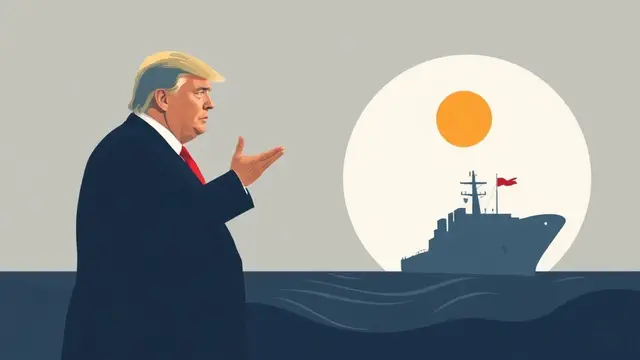
President Donald Trump said this evening that the United States is expected to strike Iran again, today. “We’re going to attack them very hard today,” he said at the White House amid mutual threats and continuing tensions with Tehran. “We were very close to a deal, but they keep dragging us along,” the president explained as the reason for the planned attack.
In a surprising moment during his statement, Trump revealed that recently, and without the Iranians knowing, the United States had taken control of 22 ships carrying millions of barrels of Iranian oil. “Iran did not know about this until this moment,” he said. “Now they will have to pay the price.” Earlier, Trump posted a sharp statement, writing: “It took them too long to negotiate a deal that was great for them, now they will have to pay the price!!!”
He later addressed the state of Iran’s military and claimed that “much of it, like their navy and air force, no longer even exists, they have been completely defeated.” He also wrote that Iran is “just talking,” adding: “The Middle East bully is DEAD!!!” Trump also told Fox News that he is close to ordering further strikes on power stations and bridges in Iran.
Iran’s president responded to the American threats and warned against harm to civilian infrastructure, saying that “vital infrastructure is the lifelines of the public.” He said threats against transportation, electricity and water networks “are not a display of strength, but a sign of desperation in the face of a people’s will.” He also stressed that Iran “will stand firm against any pressure or threat.”
Parliament Speaker Mohammad Bagher Ghalibaf responded to the threats, saying that “any aggression against Iran will be met with a decisive and immediate response.” According to him, “despite the deaths of commanders and scientists, the country’s defensive and deterrent capabilities have not diminished.”
As tensions between Iran and the United States continue to escalate, Tehran is trying to project a dual message, an outstretched hand for negotiations, but also a clenched fist. Senior regime figures accuse the Trump administration of sabotaging diplomatic efforts and make clear that they will not yield to American pressure. While diplomatic contacts over Iran continue behind the scenes, Tehran says diplomacy and military force are not separate tracks but two complementary tools.
Iranian Foreign Ministry spokesman Esmaeil Baghaei said: “The diplomatic process does not happen in a vacuum. To advance any negotiation or diplomatic process, a minimal space is needed to move the work of diplomacy forward.” Baghaei attacked Washington and accused it of “hurting this process with mixed messages, shifts in positions, repeated demands and repeated violations of the ceasefire. The Zionist regime is also hurting this process with repeated violations of the ceasefire in Lebanon. Any diplomatic process is harmed by the use of force and illegal actions.”
He said, “Diplomacy and the battlefield are not two separate things. Together, they are tools for safeguarding Iran’s interests and national security. Wherever needed, our armed forces will respond firmly to the enemy.”
Against the backdrop of the security tensions and regional efforts, Iranian President Masoud Pezeshkian tried to convey a message of resilience in the face of outside pressure, alongside a desire to break out of the ongoing cycle of confrontation. “We must get out of the state of ‘no war and no peace,’” he emphasized. “War is certainly not in the country’s interest. If they want to attack, we will not fold. Let them dream about it. Our Iran will not surrender to its enemies.”
In the conservative Iranian newspaper Kayhan, which is considered a mouthpiece of the regime, a more hardline vision was presented. An article published this morning claimed that Iran can no longer rely on legal mechanisms or international agreements to secure its rights, and that the central lesson from the confrontation with the United States is that “the only language Washington understands is the language of force.”
It was also written that Iran should adopt what is called the “Hormuz trigger mechanism,” a concept under which the Strait of Hormuz would become a strategic deterrent tool to ensure compliance with commitments made to Iran. The article claimed that so far, American withdrawals from agreements and the imposition of sanctions have not exacted a real price from the United States, but using the Strait of Hormuz as leverage would change the equation and shift the consequences directly to “the pulse of the world’s energy.”
According to Kayhan, delays in decision-making and giving opportunities for negotiations allow the enemy, in its view, to avoid paying a real price. “The Strait of Hormuz operates like a button that stops the flow of global energy,” it said. In its view, just as the United States can apply pressure through control of the global financial system, Iran can, through a single operational decision, stop the flow of global energy and apply counterpressure. “Control of the Strait of Hormuz could turn Iran from a country under sanctions pressure into a country capable of influencing the entire global energy supply chain.”
The same event, reported separately by each outlet. Open a few to compare what different newsrooms emphasize — and what they leave out.



Not the same event — other stories that share this one’s people, places, or theme: background, reactions, and follow-ups.

