
FIFA Erases Culture for Profit, and It Is Not the First Time
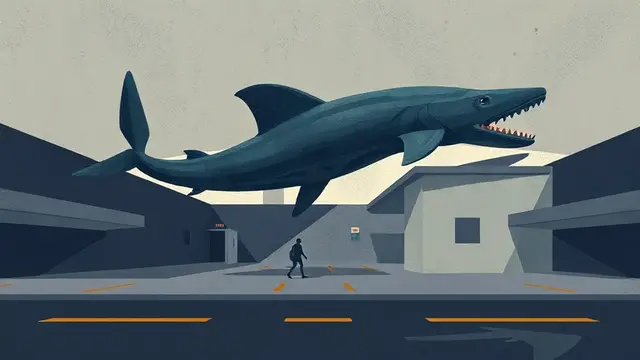
1 For nearly three decades, the massive concrete wall of the multi-story parking garage at 505 Akard Street in downtown Dallas, Texas, was home to giant blue whales. The mural “Ocean Life,” a monumental work by international artist Robert Wyland, about 25 meters high and 48 meters wide, was unveiled in 1999 and became part of the city’s architecture. A visual landmark, an anchor of aesthetic sanity in a jungle of concrete. ● IDF forces return to Beaufort, and the story opens again ● 100 years for the musical genius who taught an entire industry to leave its comfort zone
A few weeks ago, the wall was painted over completely with an opaque, robotic layer of generic blue. Why? The city is preparing to host the 2026 World Cup, and the management and real estate companies that hold the property rushed to clear this valuable public space in order to prepare it for giant FIFA signs and official sponsors. The whales were sent to the depths so that Coca-Cola or Nike could use the city as a blank, clean slate. Wyland did not stay silent and filed a $25 million lawsuit against the building owners and FIFA. The case has become a perfect, almost dystopian, example of the way capitalism erases communal cultural memory in favor of sterile branding.
2 At the heart of Wyland’s lawsuit is a fascinating 1990 law called the Visual Artist Rights Act, or VARA. In the American legal landscape, which almost worships private property above all else, this law is an alien import. It brings in from Europe the concept of the artist’s “moral rights,” and states that if a public work has reached the status of “recognized stature,” the property owner may not alter or erase it without the creator’s consent, even if the physical structure itself is registered in his name. A socialist gem at the heart of capitalism. Real estate developers naturally despise VARA. It ties their hands and forces them to consider elements that have nothing to do with capital, such as “community” or “culture.”
One contribution to the birth of the law came from minimalist sculptor Richard Serra, who installed a massive steel wall, 36 meters long and 3.6 meters high, in a federal public plaza in Manhattan. The sculpture split the square in two. Office workers in the area hated the work, said it was ugly and even invited terrorism as a bomb shelter, and demanded that it be moved. Serra sued, arguing that the work was “site-specific” and that moving it was tantamount to destroying it. He lost because there was no appropriate law at the time, and the sculpture was cut into pieces and thrown into a government warehouse. The shock in the art world over that case led Congress to pass VARA a year later.
3 The last time something like this blew up was at the iconic graffiti complex 5Pointz in Long Island City in 2018. A developer who wanted to anger the artists opposing a luxury tower project whitewashed the walls in the middle of the night. He was hit by the court with a $6.7 million fine, paid directly to the artists. In another case, Arturo Di Modica, the sculptor behind the famous “Charging Bull” on Wall Street, threatened to use VARA when the city, on International Women’s Day in 2017, placed Kristen Visbal’s “Fearless Girl” in front of it. Di Modica argued that changing the space distorted his original intent and unilaterally turned his bull into a villain. The case did not reach a full court ruling, because the city moved the girl statue, but the case showed that VARA may also protect a work against contextual changes that undermine the artist’s intent.
4 But the real interesting story here is the cause of the erasure, namely the monstrous marketing machine of the World Cup. FIFA operates under a strict code known as “Clean Site.” When this giant corporation lands in a host city, it forces that city to align with its economic needs. Its rules require local authorities and property owners to create entire sterile radii around event venues, cleared of any trace of branding, signage, or art that did not pay a fortune for the right to appear there. It is hard to ignore the irony of marketing the World Cup as a celebration of “cultural diversity” and connection between peoples, with slogans about unity and openness, while in practice producing brutal cultural uniformity. This clash exposes a deep gap. On one side stands local culture, mural art embedded in its geographic and human setting, aging with the building, absorbing the city’s soot, fading in the sun, and becoming an inseparable part of the residents’ collective memory. It represents stability, community, and continuity. On the other side stands a monstrous commercial pop-up that arrives, extracts billions, creates a brief mass euphoria, and moves on to the next destination. A nomadic culture that does not care about tomorrow, often leaving behind useless ghost facilities and erased walls. Wyland’s demand for $25 million creates a humorous capitalist paradox, in order to protect itself from big money, culture must use the only language corporations understand, an exorbitant price.
5 French sociologist Marc Augé once coined the term “Non-Place” to describe duplicated, identityless spaces such as airport terminals or shopping centers. Places where the modern consumer never feels foreign, because there is nothing local in them. They do not engage in dialogue with history or with the surrounding community. They are focused solely on the visitors’ wallets. By demanding sterile spaces, FIFA is trying to turn host cities into a sequence of “non-places.” The whales were erased because they gave soul, uniqueness, and identity to a functional, everyday parking garage. Their removal returned the concrete to its neutral and boring state, a generic space that could be anywhere and nowhere. The human imprint is once again sacrificed on the altar of economic bonanza.


