Another Night of Violent Riots in Belfast Raises Fears of a Return to the Darkest Days

Another night of violent riots broke out in Belfast, Northern Ireland, amid the aftermath of the shocking attempted murder earlier this week. Police used water cannons and riot-control measures, while the victim's family issued a surprising public appeal.
New brief: A second consecutive night of rioting and severe violence on the streets of Belfast. Steven Ogilvy's family called on the public to avoid violence and not exploit their private tragedy. Hadi Alodid, the Sudanese immigrant who attacked Ogilvy, was charged with attempted murder. Senior officials in Britain sharply criticized the rioters. The Northern Ireland secretary said, "What is it if not racist bullying?" Northern Ireland is worried about a return to the violent riots of previous decades.
Belfast experienced another wave of violent unrest overnight, between Wednesday and Thursday, against the backdrop of the serious stabbing incident earlier this week, in which a migrant from Sudan tried to murder and behead a local resident. As police clashed with rioters in the city's streets, the family of Steven Ogilvy, who was seriously injured in the attack, survived the attempted murder and lost one of his eyes, issued a public call for calm and made clear that it opposes violence and attempts to exploit the incident to incite against immigrants and minorities.
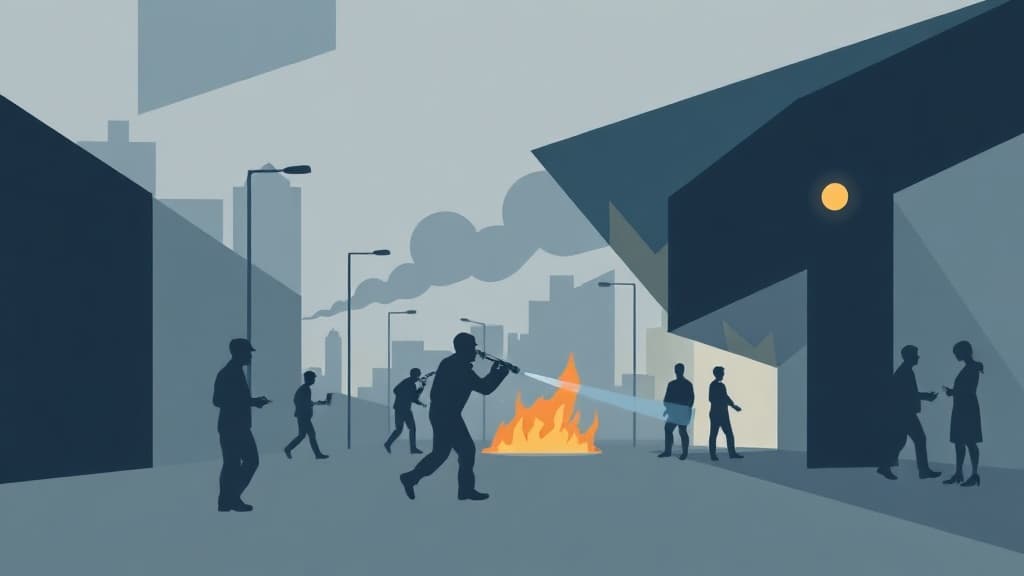
The riots erupted earlier this week after a video documenting the attempted murder was spread on social media and widely shared. Over two nights of chaos, homes, vehicles and a bus were set on fire, and families were forced to flee their homes. British media quoted officials as saying that ethnic minorities and Black residents were the main victims of the rioters. Police had to help some residents flee burning homes. In different parts of the city, the skeletons of burned-out cars and badly damaged houses could be seen.
Overnight, on the second night of the rioting, the forces used water cannons and armored vehicles against dozens of young people who threw bricks and fireworks at police officers. However, it was reported that the scale of the violence was smaller than the previous night.
Ogilvy's family issued an unusual statement through the police, expressing shock at the scenes in the streets. "We want to make it absolutely clear that the riots are unacceptable to us, and that peaceful protest is the only way forward," it said.
The family emphasized that many immigrants make an important contribution to society, including in the health system and the service sector, and called on people not to use their personal tragedy to stir up hostility or division, according to the statement. They also asked the public to stop spreading false information on social media and to pass any relevant information only to the police.
Ogilvy, a man in his 40s, was seriously injured to his face and back during the attack that took place on Monday. His condition was described as stable. The suspect, Hadi Alodid, a 30-year-old Sudanese citizen, was brought to court and charged with attempted murder, and the court ordered that he remain in custody.
British Prime Minister Keir Starmer condemned the string of events in the capital of Northern Ireland, saying the attack raises difficult questions, but stressed that driving people from their homes and attacking innocent people is not a legitimate response. He said those involved in the riots would be identified and prosecuted.
Northern Irish leaders also strongly criticized the violence in the protests. Northern Ireland First Minister Michelle O'Neill called the acts "disgusting cowardice," while Justice Minister Naomi Long said bad-faith actors had exploited the public anger and fear following the attempted murder "to incite against people whose only crime is the color of their skin."
The Northern Ireland police chief said 200 additional officers had been deployed on the streets following calls on social media for further protests. He said the rioters had harmed not only ethnic minorities, "but society as a whole."
Media figures and politicians in Britain expressed concern about the role social media played in spreading content that fueled the escalation, often inaccurately or misleadingly. According to estimates, some of the violence was organized and amplified through posts and messages circulated on various platforms.
The latest riots add to a series of similar incidents in Northern Ireland in recent years following crimes attributed to immigrants. Although immigration to Northern Ireland was relatively low for many decades, the number of immigrants has risen in recent years, alongside a hardening of public attitudes toward them. Census data from 2021 showed that 96.6% of Northern Ireland's residents are white, and 2025 saw a record number of racist incidents.
Hilary Benn, the minister for Northern Ireland in the British government, attacked the rioters. When asked, "Is this about racist riots and not protests?" Benn replied, "Well, if you attack people based on the color of their skin, how can you describe it? This is racist bullying. There is no doubt about it, because we are a society where, as Martin Luther King said, people must be judged by the content of their character and not by the color of their skin."
The current events are bringing back memories for many of the Troubles in Northern Ireland, the violent conflict that lasted for about three decades between Irish nationalists and pro-British loyalists. Belfast council member Paul Doherty said the images from the previous night reminded him of stories about families being burned out of or driven from their homes in the 1960s. "People still carry the trauma of those days," he said. "We know where this road leads. We must not allow irresponsible crowds in 2026 to repeat some of the darkest chapters of the past. That's exactly how it felt tonight."
The same event, reported separately by each outlet. Open a few to compare what different newsrooms emphasize — and what they leave out.

Not the same event — other stories that share this one’s people, places, or theme: background, reactions, and follow-ups.