A Parent’s Worst Nightmare: A Child Wakes Up Limping for No Apparent Reason. Is There Anything to Do?

One of the most frustrating, mysterious and frightening medical enigmas in modern science / artificial intelligence
Imagine the most ordinary morning in the world. Your 8-year-old child wakes up, gets out of bed, and suddenly you notice he is limping. He did not fall at school, there is no bruise, no fever. You tell yourself, “It’s probably just growing pains, it will pass.” But the days go by, the limp does not go away, and eventually you find yourself in front of an orthopedist who says the two words that will change your life for years to come: Perthes disease.
Welcome to one of the most frustrating, mysterious and frightening medical enigmas in modern science, a disease that sends the greatest doctors back to square one. “We have known this disease for more than 100 years, and a decade ago we even marked 100 years since its discovery at an international conference,” says Dr. Menachem Zinger, a pediatric orthopedic specialist who completed advanced training at one of the world’s leading centers for research on the disease. “And yet, with all the technology we have today, no one in the world really knows what causes it, how it will end, or what to do.”
The blackout of the hip joint
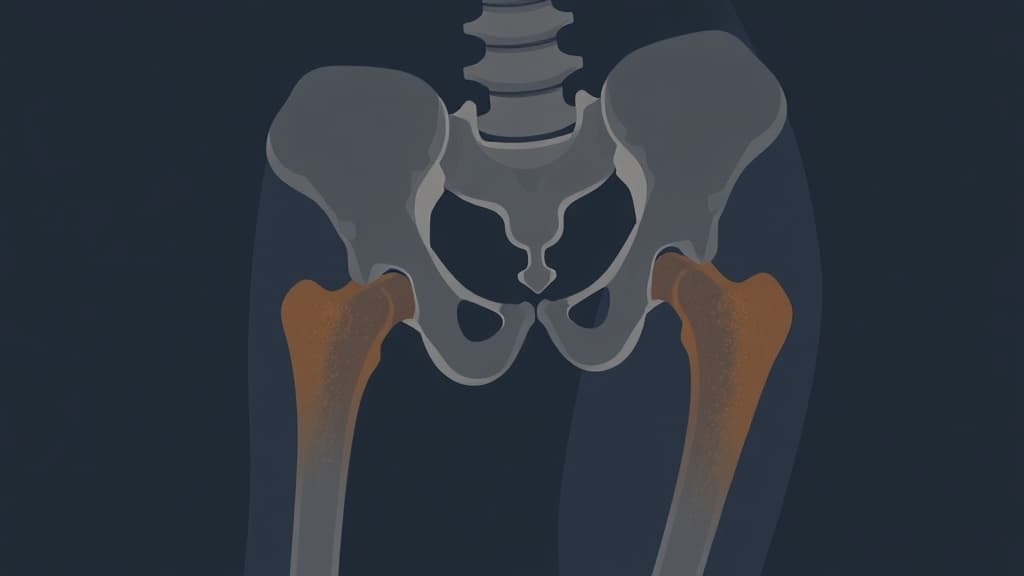
The biological mechanism of Perthes sounds almost like a random crash in the body’s operating system: for reasons no one understands, the blood supply to the head of the child’s femur is suddenly cut off. Without blood and oxygen, the bone cells in the area begin to die, and the joint, which is supposed to be round and smooth, starts to lose its shape, undergo necrosis and even collapse. The disease mainly affects boys, mostly between the ages of 4 and 8, and science has largely been left with theories.
“Countless hypotheses have been raised about the ‘why,’” explains Dr. Zinger. “There was a study in London that showed more cases in poorer and more polluted neighborhoods, and there are claims that it is linked to air pollution in certain areas, but no one has ever managed to prove anything scientifically.”
The major trap of this disease is that it works like a long, nerve-racking hourglass: it lasts between two and four years. During those years, the body tries to clear out the dead bone and rebuild it. “This disease always heals on its own in the end, the bone will always be rebuilt,” Dr. Zinger says. “The only question is what the end result will be. Will the femoral head be rebuilt in a round and beautiful shape, or will it remain flat, elliptical and deformed. If it remains deformed, the meaning is devastating, the joint wears out completely in an irreversible way.”
The faces of Perthes disease are extreme and unpredictable, and no two cases are alike. Dr. Menachem Zinger / Private photo
The parents’ mistake and the surgery at age 80
One of the biggest problems is parental awareness, or more accurately, the lack of it. Many parents tend to confuse Perthes with temporary “growing pains” and lose precious time. According to Dr. Zinger, there is a very simple way to tell the difference: “Normal growing pains are not accompanied by limping. The moment there is pain focused in the hip, and there is limping and restricted movement, this is not growing pains, and an immediate examination is needed.”
In most cases, treatment is conservative and based on physiotherapy, hydrotherapy, swimming and cycling, with the aim of keeping the joint moving while the bone rebuilds itself. In more complex cases, doctors are forced to operate in order to change the bone angles and release tendons. But the real stories, the ones that shake the orthopedic ward, happen when the disease wins and leaves behind a destroyed joint.
“Last year we had to perform a full hip replacement on a 15-year-old girl and a 17-year-old boy,” reveals Dr. Zinger. “Hip replacement is usually an operation done for older people, not high school students. But they were suffering such terrible pain and such severe limitation that they simply came and said they did not want the medications or the treatments, they just wanted the joint replaced.”
The problem with such surgery in adolescence is that it is a ticking time bomb for the future: “A successful implant, even the most successful one, lasts about 30 years. That means these teenagers will have to undergo another complex replacement surgery at age 35 or 40, and every repeat replacement is much harder and more complicated.”
To fight this statistic, medicine uses special equipment for these young patients, ceramic implants instead of plastic ones that last longer, and cementless technology that makes future replacement easier.
Dr. Menachem Zinger on the zap Doctors website, to Dr. Menachem Zinger’s website
The roulette of the hip joint
The faces of Perthes disease are extreme and unpredictable, and no case is like another. “Just in the last two weeks I saw two extremes of the disease,” Dr. Zinger concludes. “One child came to me already three years deep into the disease, but his condition is fantastic, he runs, plays soccer, has excellent range of motion and nothing bothers him in life. On the other hand, a small child came in, completely limited in movement, and I am already preparing him and scheduling him for the operating room in a week or two.”
The bottom line for parents is clear: do not gamble with your children’s legs. If a child starts limping, do not wait for a miracle to happen on its own and do not listen to advice in forums about “growing pains.” A quick diagnosis by a pediatric orthopedic specialist is the difference between returning to the soccer field and a nightmare of surgeries at an age when they are supposed to be celebrating life.
Dr. Menachem Zinger is a senior specialist in pediatric orthopedics and head of the pediatric orthopedics unit at Wolfson Medical Center, with expertise in Perthes disease.
** The information in this article is general only and does not replace professional medical advice The article is in collaboration with zap Doctors



