
Israel's Fuel Prices Drop Sharply in July Amid Global Market Changes
Translated & summarized from Behadrei Haredim by baba
Israel's Ministry of Energy announced a 32-agorot drop in July fuel prices due to lower global gasoline costs, effective from midnight Wednesday. The price cut marks the largest monthly decrease in three months, though a stronger US dollar has limited savings for consumers.
The story in 6 lines · by baba
- Fuel price in Israel drops 32 agorot per liter for July 2026, effective midnight Wednesday.
- Maximum price for 95-octane gasoline at self-service stations set at 7.48 shekels including VAT.
- Full-service fueling surcharge remains unchanged at 25 agorot per liter.
- Eilat sees a 27-agorot price drop to 6.34 shekels per liter for self-service fuel.
- Price decline driven by weaker international gasoline prices and reduced supply risk.
- US dollar strengthening against shekel partially offsets fuel price reductions for consumers.
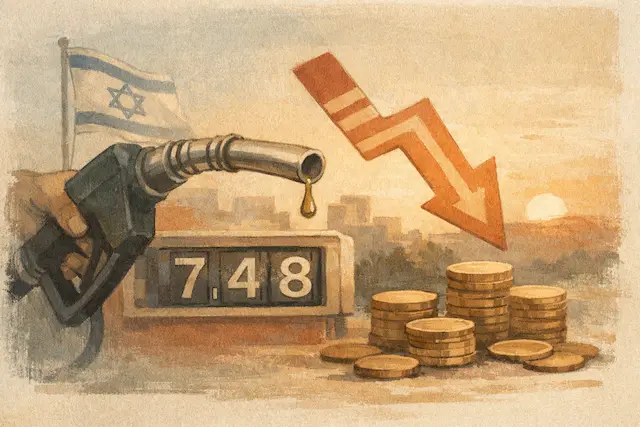
The Israeli Ministry of Energy and Infrastructure announced a significant reduction in fuel prices for July 2026, with the maximum price for a liter of 95-octane gasoline at self-service stations falling by 32 agorot to 7.48 shekels, including VAT. This new price will take effect at midnight between Tuesday and Wednesday. Drivers opting for full-service fueling will pay an additional 25 agorot per liter, unchanged from previous months. In Eilat, the maximum price for self-service 95-octane gasoline will be 6.34 shekels per liter, a decrease of 27 agorot, with a full-service surcharge of 21 agorot excluding VAT.
Batsheva Abuhatzira, head of the Fuel and Gas Administration at the Ministry, described this as the most significant monthly price drop in the past three months. Since April, the price of gasoline has decreased by a total of 59 agorot per liter. The decline is mainly attributed to weakening international gasoline prices due to reduced risk premiums and easing concerns over potential disruptions in global oil supply. However, the strengthening of the US dollar against the shekel has partially offset the price reduction for Israeli consumers, acting contrary to the global fuel price decline.
Mentioned









