Early Animal Life Evolved Slowly Until Sexual Reproduction Took Hold

For most of Earth’s history, life was single-celled. Multicellular animals appeared only in the Ediacaran period, 635 million to 541 million years ago, and the earliest forms were strange, plantlike or amoeba-like creatures living on the seafloor without mouths, eyes, legs, or fins. A new study says these first animals evolved very slowly at first, before a later burst of diversification helped set the stage for the Cambrian explosion.
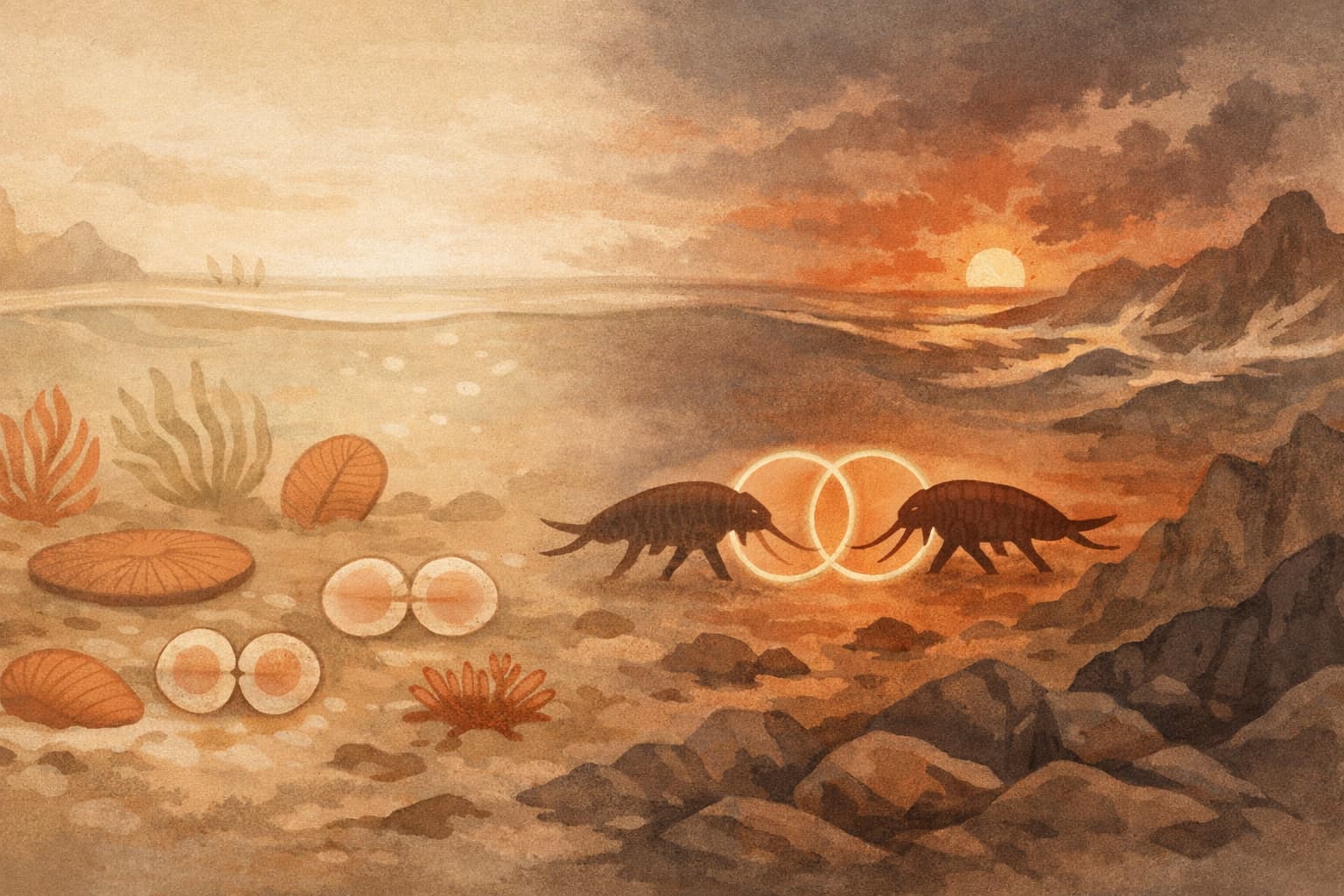
Researchers focused on an unusually rich fossil layer on Newfoundland, Canada, dated to 574 million to 560 million years ago. They concluded that these organisms reproduced asexually, by sending out body extensions that remained attached to the parent colony. According to lead researcher Emily Mitchell, “The life was pretty comfortable in the Ediacaran, so the need for sexual reproduction was fairly limited.” With little competition and a stable environment, the pressure to evolve was weak, and new species formed slowly. The colonies may have been replaced only once every 10 to 100 years, or perhaps even once every 1,000 years.
The picture changed around 550 million years ago, during the Ediacaran’s “second wave.” Fossils from places including the White Sea in northwestern Russia showed a harsher, shallower environment more vulnerable to tides, storms, and temperature swings. In that setting, colony die-offs happened two to three times a year, not once in decades or centuries. That stronger selection pressure favored sexual reproduction, which creates greater genetic variation by mixing genes and releasing gametes or larvae into the water, allowing offspring to drift farther and spread into new areas.
Mitchell said, “If you suddenly find yourself in an environment that kills you several times a year, it changes everything.” The resulting rise in competition, both within and between species, likely accelerated diversification and may have helped pave the way for the Cambrian explosion a few million years later. The researchers say more fossils and more studies will be needed to confirm the full chain of events.

