Feynman’s Restaurant Dilemma, Solved Decades Later

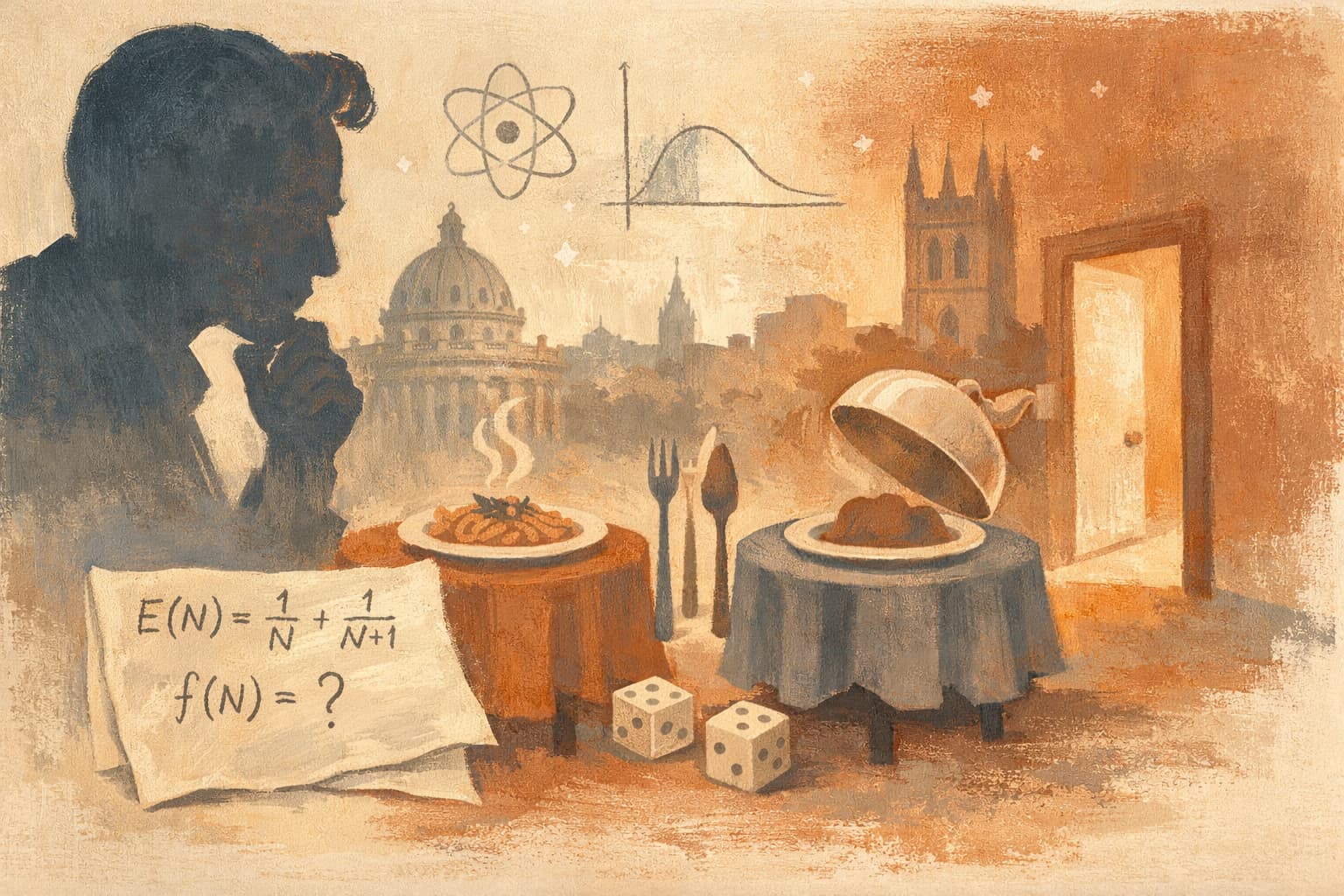
A new study has shown that Richard Feynman’s famous napkin equation from the late 1970s really did capture the optimal way to decide whether to repeat a good choice or try something new. The original story involved Feynman and his friend, filmmaker Ralph Leighton, at a Thai restaurant they frequented regularly, where Leighton wondered whether to order his usual ginger chicken or take a gamble on another dish. Feynman framed the choice as a mathematical problem under uncertainty and wrote a formula on a napkin.
For years, the result remained unpublished and unverified. After Feynman’s death, Leighton inherited the napkin collection and worked with decision-theory and game-theory researchers to decipher it. They reached agreement in 2013 on the structure of the problem and Feynman’s proposed solution. Now, a team from Oxford, Princeton and the City University of New York has proven for the first time that Feynman’s answer was optimal, and that it can be applied to related decision problems. The paper, published this month in PNAS, also drew on more than 2,500 participants and found that people make similar choices in practice.
The equation weighs the quality of the current dish, the expected range of possible dishes, and how many opportunities remain to return to the restaurant. In a simple two-day example, a low-quality first meal would justify switching, while a high-quality one would not. As Prof. Eyal Winter explained, “The main insight is that the more time we have in a destination and the more chances we have to enjoy a new choice, the more it pays to explore and switch.” When time is short, he said, it is better to stick with something that already works.
The researchers say the same logic applies to broader “stopping problems,” such as hiring, where one must decide when to stop searching and accept a candidate. Dr. Ran Snitkovsky noted that the idea also extends to search-and-exploit dilemmas in parking, dating, housing, AI training, robot navigation and even financial models such as Black-Scholes. The article also stresses that people are not perfectly rational, because personal tastes, risk attitudes and desire for variety all affect real-world choices.


