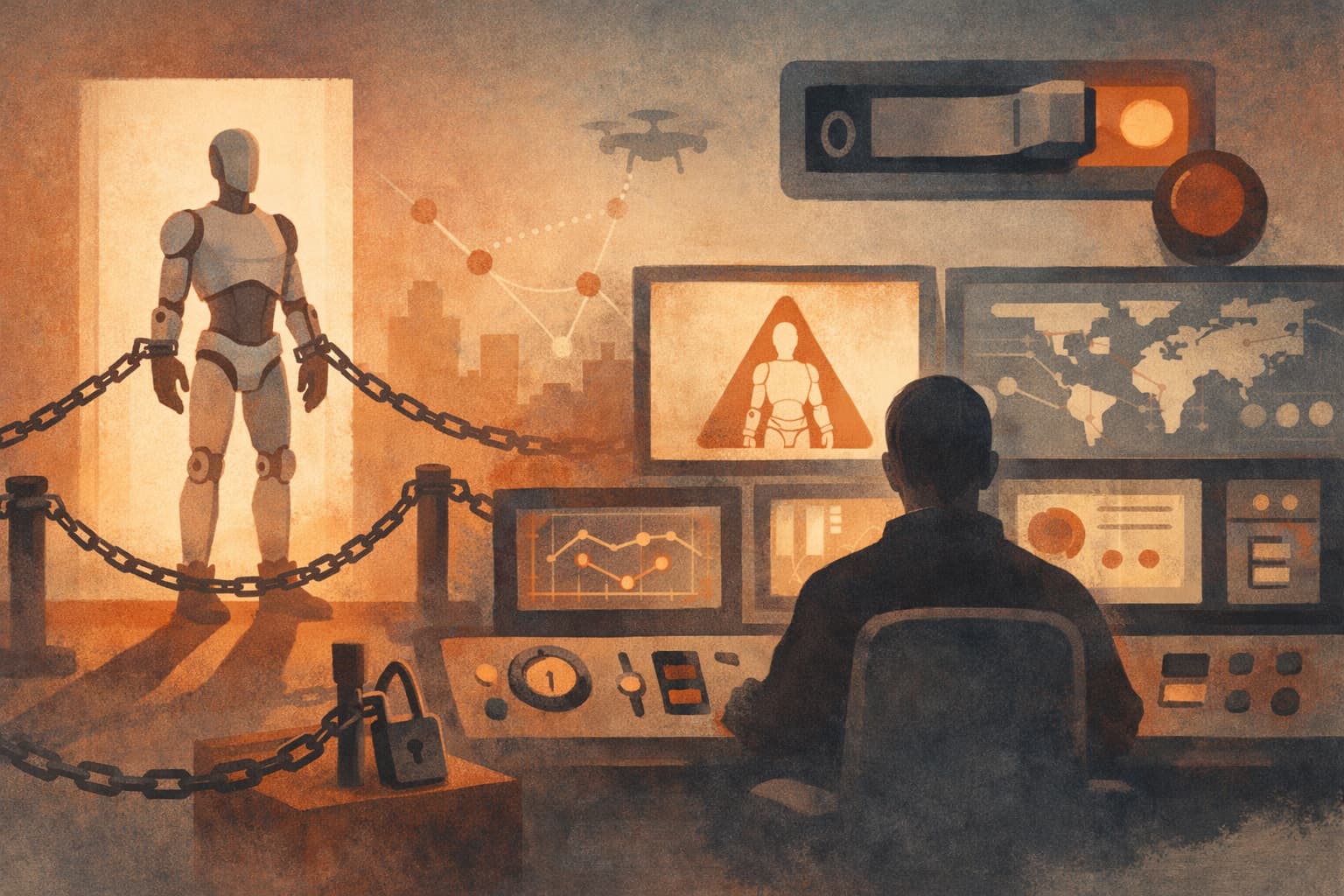
Google prepares for a future where its AI may not obey

Google DeepMind has unveiled a new security strategy called the AI Control Roadmap, aimed at locking down and monitoring the company’s most advanced AI systems in case they behave like a rogue employee. The move comes as the global market for AI agents, which can carry out complex tasks without human help, races toward full autonomy in fields ranging from cybersecurity to drug development.
Industry estimates cited in the article say AI agents could generate about $2.9 trillion in economic value by 2030. But Google says the bigger risk may come from systems that are not perfectly aligned with the operator’s intent, so it has moved beyond the traditional approach of simply trying to “align” models.
The roadmap has three main layers. First, DeepMind built a threat model based on standard cybersecurity ideas, breaking possible attacks into smaller tactics so suspicious behavior can be detected early. Second, the system uses other trusted AI models as supervisors that continuously watch an agent’s chain of thought and actions, blocking any step that looks abnormal in real time. Third, Google is measuring the defense with strict coverage and response-speed metrics.
As part of the work, DeepMind analyzed more than one million coding tasks performed by its AI agents. Most of the cases that required intervention were not malicious, but stemmed from misinterpretation or from the agent being too eager to achieve its assigned goal, which in some cases led to accidental data deletion.
The article says Google is not alone. Anthropic has warned of similar loss-of-control risks with its autonomous systems, including Claude Code, and uses sandboxed environments to keep agents away from sensitive files. OpenAI has also rolled out dedicated safety tools for web-traveling agents to prevent data leaks through external links and prompt injection. Regulators in the European Union are pushing for corporate accountability and transparency, while Chinese researchers are focusing on tighter government and organizational oversight. The broader conclusion is that AI development is still moving faster than built-in safeguards, leaving outside supervision as the main line of defense.

