
Jellyfish: Ancient, Brainless, and Surprisingly Sophisticated
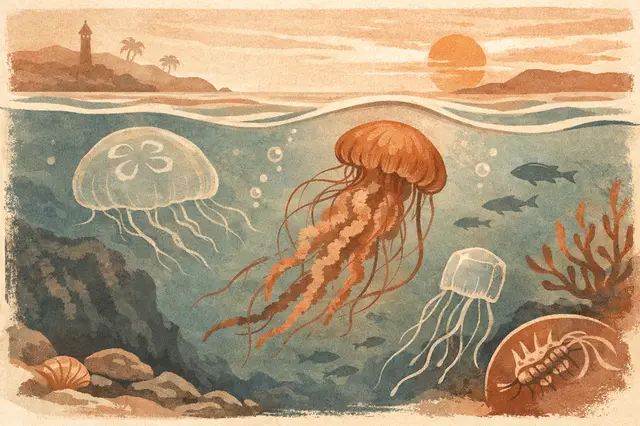
Every summer, jellyfish return to Israel’s beaches and sting swimmers, but the article argues they are far more than a seasonal nuisance. Jellyfish are among the ocean’s oldest and most efficient survivors, and despite having no brain, heart, lungs, bones or blood, they can swim, hunt, sense light, respond to their surroundings, reproduce, and in some cases kill within minutes.
Their bodies are about 95 percent water and built from three main layers, with a gelatinous middle layer called mesoglea. They breathe through diffusion, move by contracting their bell-shaped bodies, and use a single opening for both eating and waste. Most species rely on simple nerve nets, while cube jellyfish are especially advanced, with active swimming speeds of about 4 knots and relatively complex eyes, including in some species a lens, cornea, iris and retina.
The article surveys the range of jellyfish species, from the tiny immortal jellyfish Turritopsis dohrnii, which can revert from adulthood to a younger stage under stress, to massive species such as the lion’s mane jellyfish, the Japanese Nomura’s jellyfish, and the deep-sea giant Stygiomedusa gigantea. In Israel, the best-known species is the nomad jellyfish, Rhopilema nomadica, which arrived from the Indian Ocean and Red Sea through the Suez Canal and has been present in the eastern Mediterranean since the 1970s and 1980s. It can form huge swarms, sting bathers, clog fishing nets, and disrupt coastal infrastructure, though most injuries are mild to moderate.
The article also identifies genuinely dangerous species, especially the Australian box jellyfish, whose venom can cause paralysis, cardiac arrest and death within minutes, and the tiny Irukandji jellyfish, which can trigger a delayed but severe syndrome. One famous case involved Australian doctor Jack Barnes, who deliberately let a jellyfish sting him, his nine-year-old son and a local lifesaver to prove the link to Irukandji syndrome; all three became seriously ill but survived. In 2022, a 14-year-old boy died after a box jellyfish sting in Queensland, reinforcing the danger. The article says jellyfish numbers appear to be rising in some places because of warming waters, overfishing, pollution, coastal construction and invasive species, but stresses that trends vary by region. For ordinary stings in Israel and the Mediterranean, it advises leaving the water, not rubbing the area, removing tentacles carefully, rinsing with seawater only, and seeking urgent care if severe symptoms appear.





Ask About This Article
Duki reads it, and every newsroom on the same story, then answers with sources.