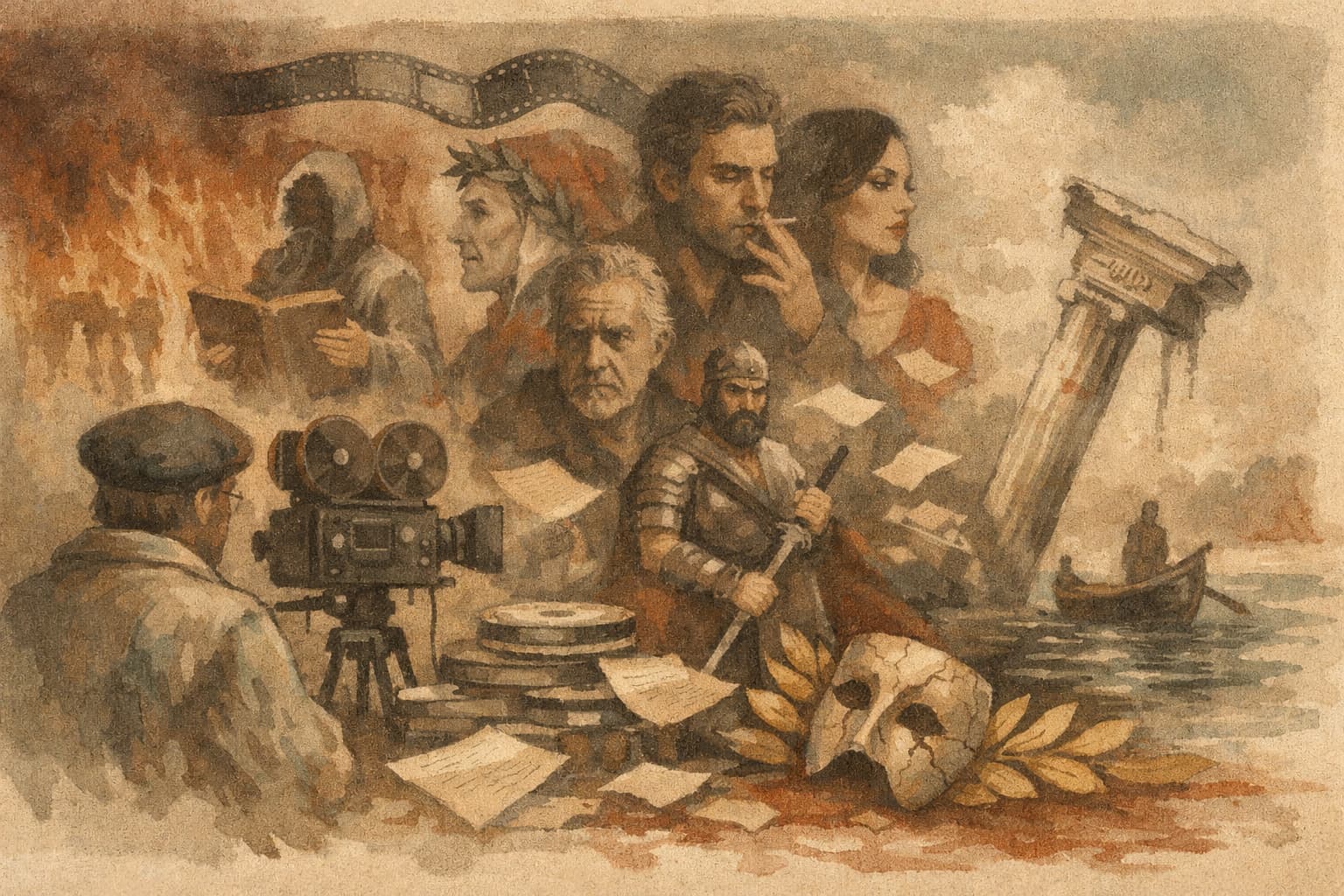
Julian Schnabel’s Dante Film Is a Bloated, Bizarre Misfire

Julian Schnabel, who became a major figure in New York’s art scene in the 1980s and later built a film career around artists and outsiders struggling for expression, has released his latest movie, "In the Hand of Dante," on Netflix. His earlier films centered on Jean-Michel Basquiat, the Cuban poet Reinaldo Arenas, Vincent van Gogh, and, in a broader sense, Jean-Dominique Bauby and the Palestinian journalist Rula Jebreal’s story in "Miral." The new film again returns to the theme of creative pain and self-expression, but this time through a sprawling, fictionalized adaptation of Nick Tosches’ 2002 novel.
The film runs more than two and a half hours and jumps between two timelines. In one, black-and-white story line, Oscar Isaac plays a version of Tosches, an journalist drawn into a plot to steal and sell what is said to be the original manuscript of Dante Alighieri’s "Inferno." In the other, also played by Isaac, Dante struggles with the making of "The Divine Comedy" in 14th-century Italy. The two strands alternate, with modern characters mirroring figures from Dante’s world.
The review says the narrative is full of gaps, badly paced, and often incoherent, with scenes that linger too long or are cut too abruptly. A brief standout scene has young Tosches speaking with his uncle, played by Al Pacino, after killing a boy who threatened him, and another has Gerard Butler as a vicious mob hitman. John Malkovich appears as crime boss Joe Black, who controls the Italian gangsters from whom the manuscript must be stolen.
Butler also appears in the Dante timeline as Pope Boniface VIII, while Martin Scorsese turns up as a bearded, sage-like figure named Isaiah who tells Dante, “There is no failure in creation the way you did it. If you do not take out what is inside you, what is inside you will destroy you. If you take out what is inside you, it will save you.” Gal Gadot plays two roles, Dante’s wife Gemma Donati and Giulietta, an Italian assistant who falls in love with Tosches. The review concludes that the film is too long, cumbersome, tedious and bizarre to deliver either emotional force or intellectual stimulation, calling it a clear failure from a director who has often shown real talent.
The same event, reported separately by each outlet. Open a few to compare what different newsrooms emphasize — and what they leave out.


Not the same event — other stories that share this one’s people, places, or theme: background, reactions, and follow-ups.
