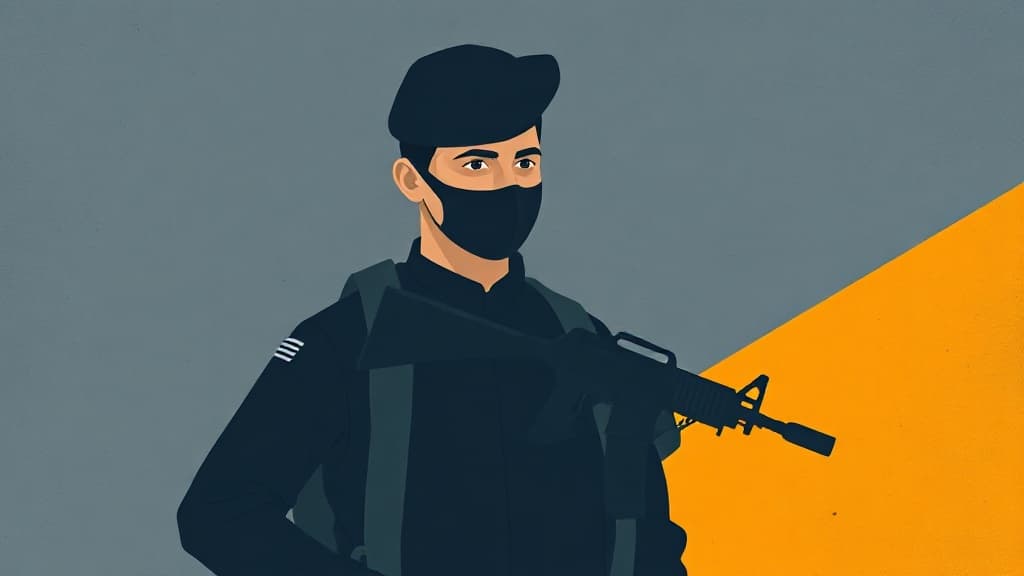
“A Haredi Soldier Needs a Haredi Commander”: Hahashmonaim Brigade Fighter Reveals Operational Activity in Judea and Samaria

Staff Sgt. Y., a fighter and trainee in the squad commanders course of the Hahashmonaim Brigade, describes nights of arrests of wanted suspects, weapons searches and security activity in Judea and Samaria. He also addresses the debate over Haredi enlistment and explains why, in his view, a Haredi fighter must have a Haredi commander.
A trainee in the squad commanders course of the Hahashmonaim Brigade was interviewed by Yossi Sergovsky in the Kikar studio and offered a glimpse into the training routine and operational activity in which the course trainees are taking part these days in Judea and Samaria.
According to him, the course also includes operational activity in the field. “There are two weeks of operational activity as part of the course. We carry out offensive activity and defensive activity, searches for weapons and arrests of wanted suspects,” he said.
He explained that most of the activity takes place at night. “The activity in Judea and Samaria is mainly at night, in order to create the element of surprise. Before the activity, we plan the arrival and all the stages of execution, and then go out at night for the mission.”
When asked what kinds of missions the forces encounter in the field, he said they include locating weapons and arresting wanted suspects based on intelligence. “We are informed about weapons hidden along routes or in villages and about wanted suspects for questioning, and accordingly we act,” he said.
In the interview, he also referred to his operational service before entering the squad commanders course. According to him, he served with his battalion on the Lebanon border, first at the Zarit post and later at the Magen Yoav post. “We were in posts in the sector and carried out disruption operations against Hezbollah activity toward Israel, as well as weapons searches in the area,” he said.
He was also asked about the public debate surrounding Haredi enlistment and whether it reaches soldiers in the field. “There is a small discussion among the friends, but in the end everyone does what his rabbi says. I spoke with my rabbi and he recommended that I enlist, so I enlisted,” he replied.
The fighter said he does not usually wear his uniform outside the base, but that he mostly encounters positive reactions. “When people meet me personally, the reactions are usually positive,” he said.
One of the topics he elaborated on was the importance of Haredi commanders within the brigade. According to him, during his training he was first commanded by commanders from the religious Zionist sector and later also by Haredi commanders. “In the end, a Haredi soldier needs a Haredi commander. There are many small things and nuances that a Haredi commander understands from his familiarity with the world the soldiers come from,” he said.
He added that one of his goals is to continue on the command track. “Right now I want to be a squad commander, and later maybe go to officers’ training too. I would like to command recruits from the moment they arrive in the army until they become fighters.”
At the end of the interview, he asked to send a brief message to the public and said: “Pray for us that we succeed.”

