Flying Transformer: Meet the Cheyenne 2, the Black Hawk’s Successor

Hello, this is the Captain. There are aircraft and helicopters that everyone loves, and it seems as if they have always been here. Sikorsky’s Black Hawk helicopter is a great example, since it has been in Israel since 1994 and has become the busiest helicopter in the IDF: inserting forces on the front line and delivering supplies to outposts, extracting a commando ambush behind enemy lines, and saving the lives of the wounded every day. For previous "The Captain" columns: 80 years of danger, how the Nazis invented Iran’s rocket city Helicopters are already there, so why not destroy Iran’s mines from the air? Anatomy of a threat, everything they did not tell you about Hezbollah’s new drones
Its popularity is not unique to Israel, right? 38 countries have purchased military Black Hawks, and rightly so. The helicopter combines reliability, damage resistance and very good performance, and of course American pressure to buy Made in USA does not hurt. 15 gallery views Israeli Black Hawk arriving to evacuate casualties from the Gaza coast (Photo: Israeli Air Force)
But it is easy to forget that the Black Hawk is no longer young, and it was designed before Yoko Ono broke up the Beatles, and before Shaya Feigenbaum hung up his boots. I checked, and there are 39 countries in the world that were born before the Black Hawk, so it is natural that the United States would look for a worthy successor, and find one. It is called the MV75 Cheyenne 2. The MV designation indicates multi-mission and vertical takeoff and landing, and we will get back to the "Cheyenne" in a moment. This is a tiltrotor aircraft made by Bell, which may one day enter IDF service. Today we will get to know it a little and learn what it can do, and why it works this way. Spoiler: it has one drawback that worries me a bit. 15 gallery views It is a plane! It is a helicopter! It is both! The MV75 in Israeli Air Force colors (Photo: Bell Textron, image processed using AI)
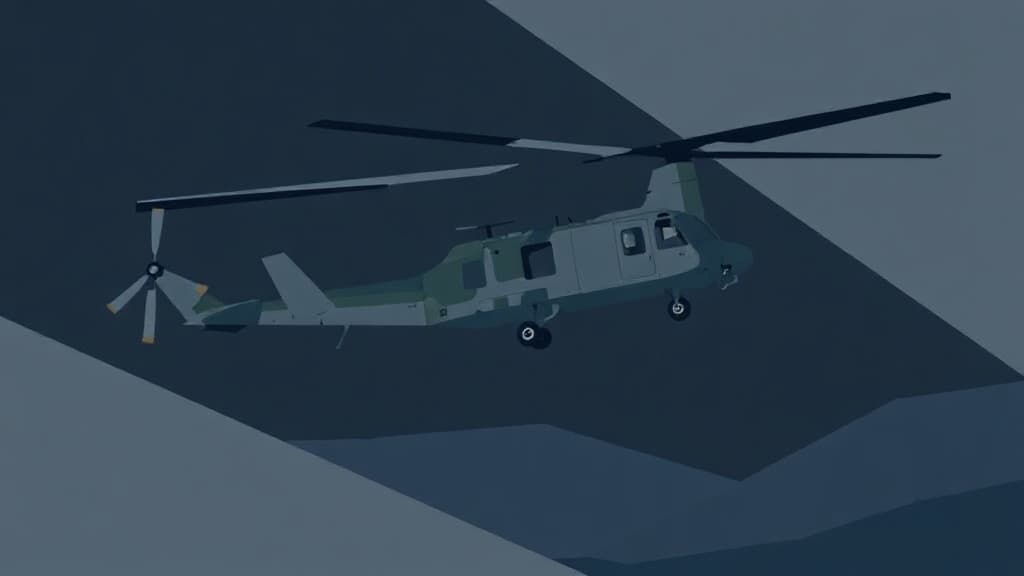
Where did it come from? In 2004, the US Army began advancing the FVL tender, designed to find an aerial platform that would preserve the flexibility of a multi-purpose helicopter, with a dramatic improvement in speed and range. I said "platform" deliberately, because a classic helicopter was not the preferred solution. The army wanted innovation, high tech, breakthroughs. The finalist companies in the competition were Sikorsky and Bell. The maker of the Black Hawk presented a helicopter with two main rotors turning in opposite directions like the famous Kamov helicopters, a two-tier rotor, and in its tail sat a propeller that added a great deal of speed. Bell, by contrast, presented a tiltrotor aircraft, a flying machine with enormous potential, but also a problematic record. 15 gallery views The winner and its runner-up, Bell’s contender and below it, Sikorsky’s (Photo: Bell Textron + Lockheed Martin, image processed using AI)
Bell’s design configuration is called tilt-rotor, tilting the propeller axis. When it is vertical relative to the ground, it generates downward force and takes off, then it is directed forward to allow horizontal flight. Technically, this gives you the helicopter’s flexibility advantage for takeoff and landing anywhere, and the airplane’s speed advantage. In addition, the wings generate lift, the engines consume less fuel, and the result is twice the range of a similarly sized helicopter. Before we continue, I will tell you that rotor tilt was first described in 1902 by brothers Armand and Henry Dufaux, and was patented by George Levberger in 1930. The double tilt-rotor design can be attributed to Focke-Achgelis in Nazi Germany, and manufacturers in the United States succeeded in building and flying such aircraft, but there is no company in the world with more tiltrotor experience than Bell. Since 1953, its engineers have worked on developing the perfect tiltrotor aircraft. 15 gallery views Right: Levberger’s patent, the Focke-Achgelis design (Photo: griffinmilitaria + dzen)
When the first model entered service, the V22 Osprey, developed together with Boeing, we will discuss it in a separate column, it turned out that the word "perfect" was too big for it, like a sombrero on a cat. It suffered an unusual number of accidents and many safety incidents because of technological teething problems and flight difficulties. But the generals were not deterred. In 2019 they announced that Bell was the winner. Its model was faster than the competitor’s and also less complex from an engineering standpoint. Bell’s experience played a huge role, while no American company had launched a helicopter with a dual rotor like the one Sikorsky presented, at least not in a complete assault helicopter configuration. There were flying machines in that structure, developed by Gyrodyne in the 1960s. 15 gallery views Nice to meet you, Bell Cheyenne 2 (Photo: The Captain project CC0)
Let’s move on, why is it called Cheyenne 2? Because just "Cheyenne" was already taken. US Army helicopters are always named after brave Native American nations that this army, somewhat embarrassingly, once tried to exterminate. For example, the Black Hawk was a chief of the Sauk tribe. Who was the first Cheyenne helicopter? It was a very ambitious 1966 project, in which Lockheed developed a combat helicopter with an almost excessive variety and quantity of weapons, a multi-barrel cannon, a grenade machine gun, six anti-tank missiles, rocket pods, air-to-air missiles, all at the same time. Development was delayed and became complicated both mechanically and politically, the Air Force felt the Army was stepping on its lawn, and the helicopter was canceled in 1969. So now the Army has recycled the name Cheyenne instead of taking another Native nation, probably because Ojibwe or Potawatomi roll off the tongue less easily. 15 gallery views Only the name remained. Cheyenne 1 in a firing display (Photo: US Army)
What can the Cheyenne 2 do? Everything the Black Hawk can do, and it also has a troop compartment of similar size. But that is where the similarities end. A typical Black Hawk cruises to its destination at about 280 km/h, while the replacement does so at 500 km/h and with a 40% heavier payload. How far can it go? Its mission radius is more than 1,400 km, more than five times that of a basic Black Hawk. 15 gallery views Extremely fast cruising. Cheyenne 2 (Photo: Bell Textron)
The Cheyenne is also a smart machine. It can receive intelligence information while in flight and send reports back to base, launch autonomous drones that provide an image of the landing zone and expose hidden threats, and the cockpit looks completely space-age. In the future, we will also see armed versions of the MV75 and versions intended for naval warfare. 15 gallery views The cockpit is almost entirely digital (Photo: US Army)
Bell and US Army promotional videos show Cheyennes flying and carrying wounded, providing humanitarian aid, landing fighters on rooftops and in deserts, everything expected. And it looks really good, really. I am sure it will receive more improvements and upgrades before entering service in 2031. But there is something basic that bothers me, and it has to do with what happens when things do not go according to plan. 15 gallery views Naval version illustration (Photo: Bell Textron, image processed using AI)
You see, a Black Hawk that loses an engine because of a malfunction or enemy fire can continue flying on the other engine. There is a transmission system that allows the rotor to keep turning, and it does not care whether the power comes from the right or the left. But the Cheyenne has two main rotors, and two engines that are more than 10 meters apart. In the wings run transmissions that allow one engine to turn its partner, but they are long, heavy and affect the helicopter’s survivability in combat. 15 gallery views This is an Apache that lost an engine in the Second Gulf War and landed safely at base. It is not certain the Cheyenne would have succeeded (Photo: Army Aviation Magazine)
What do I mean? In general, survivability is the combination of how hard it is for the enemy to detect an aircraft and shoot at it, and what happens to the mission when the enemy hits the target. As early as the Vietnam War, the US Army learned how challenging the survivability of its helicopters is, usually the hard way. When helicopters were sent to insert forces or evacuate casualties and flew low through winding valleys, they were less visible and were hit less. But when the helicopter approaches the landing point, slows down and descends to the ground, the risk rises. And it is most vulnerable after landing. 15 gallery views A helicopter arriving to pick up fighters in a flooded rice field in Vietnam (Photo: AP)
Theoretically, on the way to the target, the Cheyenne 2 will be less vulnerable than a regular helicopter. It flies much faster, it is very agile, and it is equipped with advanced defensive technologies. Speed alone will make it harder for the enemy to aim and fire, and the exposure time will be relatively short compared with the Black Hawk and its kind. But when the tiltrotor reaches the landing point, the situation could reverse. Because of its wide wings and engine nacelles at their ends, the Cheyenne has a larger surface area from almost every angle. That means a terrorist or enemy soldier will be able to aim at and hit it more comfortably. 15 gallery views Which one seems more conspicuous to you? (Photo: The Captain project CC0)
What would such damage do in the real world? Let’s think about the threats common in a landing zone. The range is very broad, from Kalashnikov fire to anti-aircraft missile fire. Small arms will not endanger the mechanical components in the wing or the engine, but a heavy machine gun certainly can, you know, the kind terrorists throughout the Middle East like to mount on their pickups. 15 gallery views Cheyenne 2 from the rear, deploying drones (Photo: Bell Textron)
If damage is caused both to the engine and to the transmission components connected to it, a tiltrotor like the Cheyenne may be more affected than a traditional helicopter, and may not be able to continue the mission. I promise you I am not the first to think about this. Pentagon generals have decided that the risk is justified and reasonable, that there will be an increased risk, but only in a smaller time window, that is, only when the aircraft comes to land or pick someone up. In their view, its agility will reduce the chance of being hit, even when the aircraft is most vulnerable. 15 gallery views The speed advantage improves survivability (Photo: Bell Textron)
Look how beautifully the Cheyenne 2 shows us that engineering, as groundbreaking as it may be, is always a game of trade-offs. There is no design without drawbacks and limitations. And in the same way, creative engineers will always arise and try to bypass them again. For example, I cannot tell you if and when the Cheyenne will replace the Black Hawk in the IDF, but you can be sure that if it does happen, the helicopter will undergo a long series of upgrades here. 15 gallery views Cheyenne 2 in Israeli Air Force colors (Photo: Bell Textron, image processed using AI)
It will likely receive new communications and defense systems that will help cover its weaknesses so it can complete every mission anywhere, just like its predecessor. Take care of yourselves, stay alert, and we will prevail.

