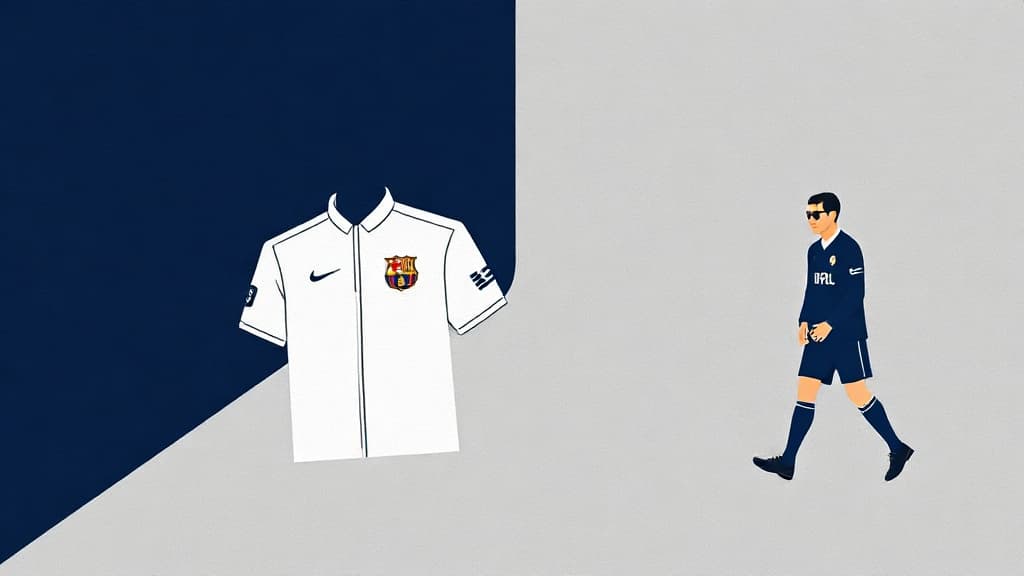
The Unbreakable Link Between Football, Music and Fashion: “Maccabi Tel Aviv Realized Fans Are Walking Wallets”

The writer is a DJ, an international music producer (Vooz Brothers), and the owner of a music company for events in Israel and abroad.
“You’re still moved by the sea, I am moved by nothing, except football,” Hanan Ben Ari sings with full intent. So much emotion, belonging, honesty and power is packed into the world’s most popular sport. And if we connect it to music and fashion, we discover a massive business, the huge industry of football shirts. It includes collaborations between the Dutch football club Ajax and reggae legend Bob Marley, Inter Milan and a Pink Floyd collection, and Paris Saint-Germain with The Weeknd, Prince and the K-pop phenomenon BLACKPINK.
Estimates speak of a market that turns over $8 billion a year, with about 300 million shirts produced. Sports giants Nike, Adidas and Puma pay huge sums to leading teams for the right to manufacture their shirts. Real Madrid, for example, receives about 120 million euros a year from Adidas. There used to be no logo, until 2011 Barcelona’s shirts did not carry a commercial logo. Today, its partnership with the main sponsor Spotify deepens its ties to the global music world. Match shirts launched for El Clásico, the game between it and Real Madrid, with logos of the Rolling Stones, Coldplay or Olivia Rodrigo are snapped up immediately and become collector’s items. Each shirt was sold for about 400 euros, in a numbered limited edition.
“Spotify pays about 75 million euros to be Barcelona’s main sponsor,” says Yoav Shalmor, an entrepreneur in the sports business and an obsessive collector of football shirts, who wears them when he DJs. At the end of 2025, the sides signed a long-term contract extension, the shirt sponsorship until 2030 and the Camp Nou stadium until 2034, which raised the total value of the deal to about 460 million euros.
Shalmor believes the connection between sports brands, culture and music is very trendy, and points, for example, to Juventus’s logo, which was completely changed a few years ago as part of a rebrand toward the lifestyle world. “The connection between football and fashion is natural. That is how the streetwear brand Off-White, whose owner and designer Virgil Abloh was himself a DJ and musician, dressed Milan’s men’s and women’s teams from head to toe on every official trip.”
Olivia Rodrigo match shirts launched for El Clásico / Photo: Barcelona’s official website, the big bang: Oasis also fires a shot
Boramtnov, head of men’s purchasing at Factory 54 and the man who upgraded the style of artists such as Ivri Lider and Ran Danker, also points to Barça: “You can’t ignore Barcelona’s collaboration with Travis Scott, for example. Or the Japanese fashion brand BAPE, which is closely associated with inspirations from football and black music and with its collaboration with Adidas. The big bang was the union of Oasis and the collaboration with Adidas, with all the context of the Gallagher brothers and their beloved football team, Manchester City.”
“This year, because of the approaching World Cup, we’ll reach some kind of catharsis when it comes to the combination of music, football and fashion. Like the American designer with Latin roots, Willy Chavarria, who designed a shirt for the Mexico national team, or the Nike collaboration with Off-White, dedicated to the U.S. national team.”
Doron Shehino from “Football Shefel,” a football culture project in Israel dealing with the periphery, the lower leagues and the world of collecting football shirts, elaborates: “The connection between football and fashion began in 1973. Leeds United were champions of England and sold the first shirt, which was actually a children’s shirt. With World Cup fever and the globalized world, fan shirts became a real fashion item. Since the 1980s, when Madonna and Michael Jackson wore shirts of Celta Vigo and Nice respectively, and up to Snoop Dogg or Drake, who wore a Juventus shirt and made it their best-selling shirt of all time.
“A football shirt is a time capsule. We all have brands like Keter, Volvo, Visa, Globus Group stuck in our heads. They are not just brands, they bring us a victory or a defeat, a player or a team, a championship song. The connection between sports brands and music stars is both commercial and natural. It has become business, but it doesn’t have to come at the expense of one or the other. As a Barcelona fan, I would be happy if it didn’t happen in El Clásico, a super sensitive game, or as part of Spotify’s marketing plan, ‘come release an album in mid-December because there is an El Clásico and we’ll brand you on the shirt.’
“On the other hand, there is the story of Ed Sheeran and Ipswich. He is a die-hard fan who became a shareholder and launched his album on the team’s shirts, which skyrocketed sales. It’s roughly like a fan from the Hatikva Quarter launching an album on Bnei Yehuda’s shirt. That is authenticity and that is romance.”
In March 2025, Maccabi Tel Aviv and Mashina launched a joint fashion capsule collection marking 40 years since Mashina’s first album and the song “Rakevet Laila,” a well-known fan anthem. This was the first official collaboration of its kind in Israel between a football team and a rock band.
Shehino explains: “At Maccabi Tel Aviv they understood that their fans are walking wallets, and I don’t mean that in a bad way. A fan wants to spend 500 to 1,000 shekels a year on his team, and they work as a brand. The Maccabi Tel Aviv and Mashina collaboration is the most basic, but honestly, they made a move that deserves respect. Mashina is an inseparable part of Maccabi’s folklore (and Yuval Banai and Shlomi Bracha are die-hard fans, DT). If ‘Shimi 10 Music Services’ sponsored Beitar Ezra from Liga Gimel in 1996, there is no reason artists should not launch an album or a new song on the jerseys of Beitar or Hapoel. In general, there is a lack of leisure culture here, and directly, a lack of sports culture. If a child has a sport or a musical instrument to play, he is less likely to look for another child to stab in a pizzeria in Petah Tikva.”
“We are still not abroad”
Tal Shorrer, host of “The Day That Was” on Channel 13 and a Hapoel Jerusalem fan, moves from the matter of shirts to a deeper look at the fans themselves. “The commercial connection in football is always challenging. The Super Bowl halftime show has become the main event and not the game, and that will not work for football fans. They really come for the game, and if they do a halftime show at the World Cup final, with Madonna and Shakira, it will have to be for a charity fund for children’s education and sports, otherwise the fans will not accept it.”
“The strong connection between football and music starts with fan songs and continues with bands performing arrangements of terrace songs,” Shorrer says. “But we are still not abroad. It is really strange why a club like Beitar Jerusalem does not, for example, connect with Dudu Aharon and his song ‘El Halev Nichnasta,’ which became a powerful fan song, or Hapoel Tel Aviv and the whole connection to Arik Einstein. Why doesn’t that happen? I don’t have a good answer.”


