Underwater Secret Revealed in Remote Lake Is Far Older Than Anyone Imagined

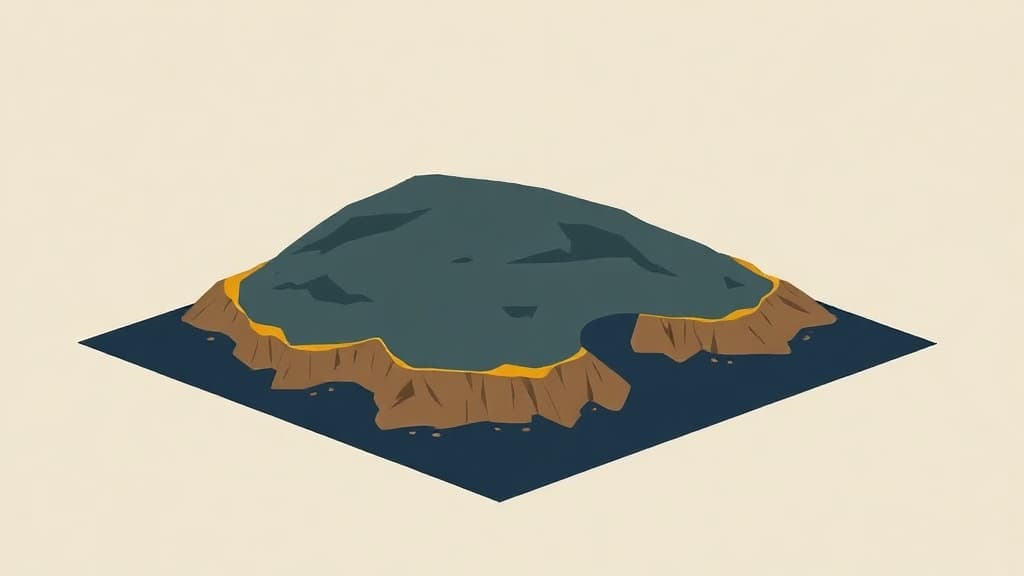
The artificial island in Loch Bhorgastail. Older even than the famous Stonehenge site / Galaxy808
We tend to think of artificial islands as a modern, flashy invention associated mainly with grand projects in places like Dubai or China, but the historical record shows that humanity began engineering nature long before we learned to write. Humans have always been drawn to freshwater sources, in fact, more than half of the world’s population today lives within less than three kilometers of lakes or rivers, but these dynamic zones between land and water are a constant nightmare for archaeologists because of the technological difficulty of studying them in shallow waters of less than one meter. Now, a breakthrough study by the universities of Southampton and Reading has solved a long-standing mystery using advanced 3D imaging technology, tested at Loch Bhorgastail on the Isle of Lewis in Scotland. Researchers turned the spotlight on what looked from above like a harmless, natural pile of rocks in shallow water. These structures, known as crannogs, are in fact tiny artificial islands built in lakes and marshes across Scotland, Ireland and Wales. For years, the prevailing assumption was that they dated to the Iron Age, but the new tests stunned the scientific world.
View this post on Instagram A post shared by Time Team (@timeteamofficial)
The secret hidden beneath the rocky shell
Under the top layer of stones, divers uncovered an astonishing engineering foundation, a broad circular wooden platform about 23 meters in diameter, covered with layers of twigs and vegetation. Radiocarbon dating determined conclusively that this extraordinary structure was built more than 5,000 years ago, in the Late Stone Age, between 3300 and 3800 BCE. That means this artificial island is far older than famous historical monuments such as the legendary Stonehenge in England. Scientific analysis showed that the island underwent phases of development and reuse by different generations over thousands of years. About 2,000 years after it was built, in the Middle Bronze Age, early humans added another layer of stones, and at a later stage a stone causeway was even built to connect the island to the shoreline, a path that is now completely submerged.
More on Walla Education loan, how can you invest in your children’s future without falling into financial turmoil? In cooperation with Phoenix
An aerial view of the artificial island in Loch Bhorgastail. The photograph shows the site’s surroundings and the boundary between land and water, where advanced scanning and research methods were used above and below the waves / Screenshot, ArchaeologyReading
In addition to the wooden foundation, researchers recovered hundreds of fragments of pottery, bowls and Neolithic vessels from the lake bed. The most fascinating part is that some of the pottery contained organic food remains, suggesting that the mysterious island served as a community center for festive meals, mass celebrations or shared rituals by complex tribes that were able to mobilize enormous manpower for the task.
More discoveries underwater
“The real Atlantis”: A whole city that was erased in an instant was discovered on the lake bed
“The Indiana Jones temple” that was discovered submerged in the Mediterranean Sea after 2,000 years
This is a 3D simulation of the artificial island Loch Bhorgastail crannog 2021, complete model by Islands of Stone on Sketchfab
The divers who defeated the murky waters
This scientific achievement was possible only thanks to a completely new technological method. While archaeologists usually use drones in the sky to map land sites with centimeter-level precision, in shallow water drones are useless because of light reflections, floating vegetation and murky sand that hide the seabed. To solve the problem, divers entered the water carrying a special frame fitted with two waterproof wide-angle cameras capable of shooting in difficult lighting conditions. The cameras moved along a precise route and created a continuous 3D model that connected the parts of the island above and below the water into one complete structure. This technology provided a perfect key to deciphering hundreds of similar structures still hidden in lakes and not yet studied, and it promises to change everything we knew about the map of ancient human settlement.


