
Scientists Dropped a Cow Into the Deep Sea, and What Came to Feed Was a Surprise
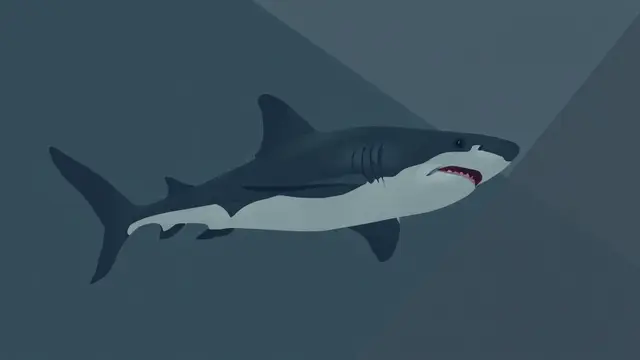
Fixed cameras deployed in the depths of the South China Sea recorded Pacific sleeper sharks of various sizes. The surprising finding was that all of the individuals observed were identified as females.
To study the processes that occur when a massive carcass sinks to the seafloor, scientists staged an unusual experiment in the South China Sea. The goal was to simulate a phenomenon known as a “whale fall,” a natural event in which a giant body becomes a concentrated food source and can sustain entire deep-sea communities for decades in a resource-poor environment. For the experiment, researchers dropped a cow carcass to a depth of 1,629 meters on the continental slope southeast of Hainan Island. What happened next surprised even the most experienced scientists. Documentary cameras placed at the site captured eight unexpected visitors, Pacific sleeper sharks. Detailed observations of these sharks have been extremely rare until now, because they can dive to depths of more than 1,000 meters and live far from human view. Unexpectedly, the video footage documented the first-ever appearance of the species in the area, and the full study, published recently in the scientific journal Ocean-Land-Atmosphere Research, offers a fascinating glimpse into their lives.
It turns out these sleeper sharks are a rather polite group. The video footage gave researchers a rare look at their predatory behavior, showing several sharks attacking the cow carcass while displaying a bizarre queueing behavior. The researchers were stunned to see some sharks courteously yield their positions to those approaching from behind. Han Tian, a researcher at Sun Yat-sen University in China, explained that the order of feeding was likely determined by individual competitive intensity, and reflects a survival strategy for communal feeding that resembles the hierarchical behavior known among predators that feed on floating whales. In addition to the surprising manners, the scientists noted significant differences in feeding strategies between the larger sharks, which were more than 2.7 meters long, and the smaller ones. While the larger sharks attacked the carcass aggressively, the smaller ones circled it cautiously. The researchers also noted clear inward retraction of the eyes during feeding. Since sharks of this type lack a third eyelid, this is a fascinating adaptation that serves as a protective mechanism during predation.
A particularly intriguing detail that emerged from the video analysis was that all of the sleeper sharks that came to feed on the carcass were actually females. Since females of other species are also common in this part of the sea, the scientists wonder whether the South China Sea may serve as an exclusive breeding and nursery area for large deep-sea sharks. Historically, this species has been documented mainly in the North Pacific, from Japan to Baja California. These observations represent the southernmost known appearance of the elusive predator to date. This helps scientists better understand its distribution, but also raises questions about the environmental and ecological factors that may be causing the shift. Although they have also been found within their normal range in the north, the frequent presence of female Pacific sleeper sharks in the South China Sea suggests that our understanding of these deep-sea predators is still far from complete.




Ask About This Article
Duki reads it, and every newsroom on the same story, then answers with sources.